Introduction to Cashless Benefits in Health Insurance
Cashless benefits are one of the most valuable features of a health insurance policy, designed to make medical treatment more convenient and financially stress-free. Under this facility, eligible hospitalization expenses are settled directly by the insurance company with the hospital, reducing the need for policyholders to make large upfront payments. Instead of worrying about arranging funds during a medical emergency, individuals can focus on receiving timely healthcare. Cashless benefits have become an essential part of modern health insurance, offering greater financial security and a smoother hospitalization experience while ensuring access to quality medical treatment when it is needed most.
What is Cashless Hospitalization?
Cashless hospitalization is a facility offered by health insurance companies that allows policyholders to receive medical treatment without paying the full hospitalization expenses upfront. Under this arrangement, the insurance company directly settles the eligible medical bills with the hospital, subject to the policy’s terms and conditions. This feature helps reduce the immediate financial burden during medical emergencies and ensures that patients can focus on their treatment rather than arranging funds.
Unlike reimbursement claims, where the policyholder first pays the hospital expenses and later seeks reimbursement, cashless hospitalization simplifies the process by enabling direct settlement between the insurer and the hospital. It has become one of the most sought-after benefits in health insurance because it offers greater convenience, quicker access to healthcare, and improved financial security during hospitalization.
How Does the Cashless Claim Process Work?
The cashless claim process allows policyholders to receive treatment without paying the entire hospitalization bill upfront. Instead, the insurance company settles the eligible medical expenses directly with the hospital after claim approval. Understanding each step of the process helps ensure a smooth and hassle-free hospitalization experience.
Step 1: Visit a Network Hospital
Choose a hospital that is part of your health insurance company’s approved network. Cashless claims are generally available only at these hospitals.
Step 2: Inform the Insurance Desk
At the time of admission, provide your health insurance card, policy details, and a valid identity proof to the hospital’s insurance or TPA desk.
Step 3: Submit the Pre-Authorization Form
The hospital prepares and submits a pre-authorization request containing your medical details and estimated treatment cost to the insurance company or Third-Party Administrator (TPA).
Step 4: Claim Assessment by the Insurer
The insurer reviews the request to verify your policy coverage, eligibility, and whether the proposed treatment is covered under the policy terms and conditions.
Step 5: Approval or Additional Information
If all requirements are satisfied, the insurer approves the cashless request. In some cases, additional medical records or documents may be requested before approval.
Step 6: Receive Medical Treatment
Once approval is granted, the hospital proceeds with the treatment while the insurance company agrees to pay the eligible medical expenses directly.
Step 7: Final Bill Settlement
After discharge, the hospital sends the final bill to the insurer. The insurance company settles the approved amount directly with the hospital, while the policyholder pays only for expenses that are not covered under the policy, if applicable.
Important Points to Remember
- Cashless hospitalization is generally available only at network hospitals.
- Claim approval depends on the policy’s terms, coverage, and successful pre-authorization.
- Keep your health insurance card and identity proof readily available during admission.
- Review your policy to understand covered and non-covered expenses before hospitalization.
Key Features of Cashless Health Insurance
Cashless health insurance is designed to make hospitalization more convenient by reducing the financial burden at the time of treatment. Understanding its key features can help policyholders choose a plan that offers better healthcare support and a smoother claim experience.
Direct Settlement of Hospital Bills
The insurance company directly settles eligible hospitalization expenses with the hospital, minimizing the need for large upfront payments by the policyholder.
Cashless Hospitalization Facility
Policyholders can receive medical treatment without paying the full hospital bill in advance, subject to policy terms and claim approval.
Access to Network Hospitals
Cashless benefits are generally available at hospitals that are part of the insurer’s approved network, providing easy access to quality healthcare.
Pre-Authorization Process
Before treatment, the hospital submits a pre-authorization request to the insurance company for approval of the cashless claim.
Coverage for Eligible Medical Expenses
The facility covers eligible hospitalization expenses as specified in the health insurance policy, helping reduce out-of-pocket medical costs.
Faster Claim Processing
Since the hospital and insurer coordinate directly, the claim settlement process is often quicker and more efficient than reimbursement claims.
Reduced Financial Stress
Cashless health insurance allows policyholders to focus on recovery instead of arranging immediate funds during hospitalization.
Convenient Hospital Experience
The direct coordination between the hospital and insurance company reduces paperwork and simplifies the overall hospitalization process.
Available for Planned and Emergency Hospitalization
Depending on the policy conditions, cashless hospitalization can generally be availed for both scheduled treatments and medical emergencies.
Financial Protection During Medical Emergencies
One of the biggest advantages of cashless health insurance is that it provides immediate financial support during hospitalization, ensuring timely access to medical care without significant financial disruption.
Benefits of Cashless Health Insurance
Cashless health insurance offers more than just financial assistance during hospitalization. It simplifies the treatment process, reduces stress during medical emergencies, and provides quicker access to quality healthcare. Understanding these benefits can help you appreciate why cashless hospitalization has become an essential feature of modern health insurance plans.
No Large Upfront Hospital Payments
One of the biggest advantages of cashless health insurance is that you do not have to arrange the entire hospitalization cost immediately. Eligible medical expenses are settled directly by the insurer with the hospital.
Faster Access to Medical Treatment
Since financial arrangements are minimized, patients can receive timely medical care without unnecessary delays, especially during emergencies.
Reduced Financial Burden
Cashless hospitalization helps protect your savings by reducing out-of-pocket expenses for covered treatments.
Convenient Claim Settlement
The insurance company directly coordinates with the hospital for eligible claim payments, making the settlement process simpler for policyholders.
Better Emergency Support
During unexpected medical emergencies, cashless health insurance provides immediate financial assistance, allowing families to focus on the patient’s recovery instead of arranging funds.
Access to Quality Healthcare
Policyholders can avail treatment at the insurer’s network hospitals, giving them access to a wide range of healthcare facilities and medical specialists.
Less Paperwork for Policyholders
Since much of the claim documentation is handled between the hospital and the insurance company, policyholders have fewer administrative responsibilities during hospitalization.
Improved Peace of Mind
Knowing that eligible hospitalization expenses are covered allows individuals and families to feel more financially secure during medical situations.
Suitable for Planned and Emergency Hospitalization
Cashless health insurance can generally be used for both planned medical procedures and emergency hospital admissions, subject to policy terms and conditions.
Better Overall Healthcare Experience
By combining financial protection, convenience, and quicker claim settlement, cashless health insurance helps create a smoother and more stress-free hospitalization experience for policyholders.
Eligibility & Documents Required for Cashless Claims
To avail of the cashless hospitalization facility, policyholders must satisfy certain eligibility conditions and submit the necessary documents at the time of admission. Having the required documents ready helps ensure a faster and smoother cashless claim approval process.
Eligibility for Cashless Claims
Active Health Insurance Policy
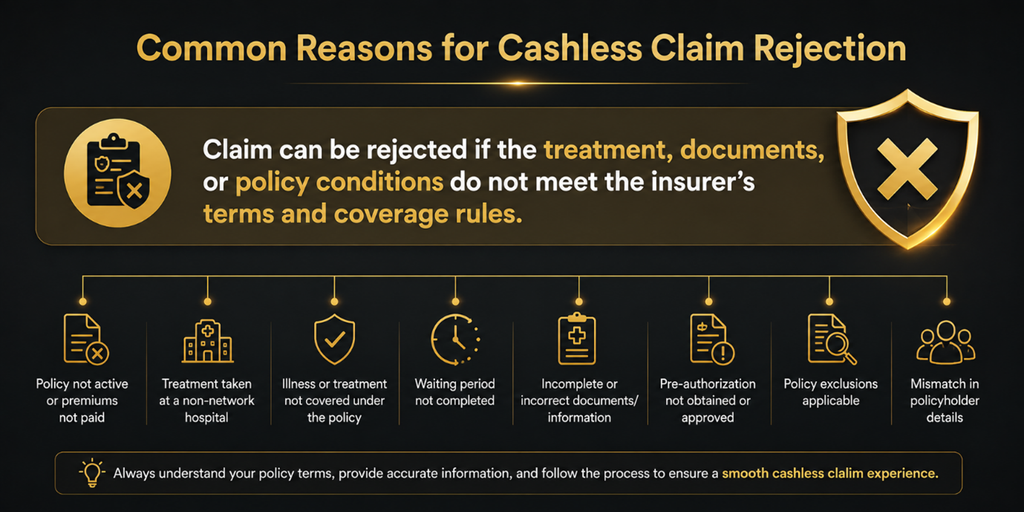
The health insurance policy should be active on the date of hospitalization, with all premiums paid up to date.
Treatment at a Network Hospital
Cashless hospitalization can generally be availed only at hospitals that are part of the insurer’s approved network.
Covered Medical Condition
The hospitalization or treatment should be covered under the terms and conditions of the health insurance policy.
Waiting Period Completion (If Applicable)
If the treatment falls under a waiting period, the cashless claim may not be approved until the waiting period has been completed.
Policyholder Verification
The insured person’s details should match the records maintained by the insurance company.
Documents Required for Cashless Claims
Health Insurance Card
The health insurance card issued by the insurer helps the hospital identify your policy details.
Valid Photo Identity Proof
Carry a government-issued identity proof such as:
- Aadhaar Card
- PAN Card
- Passport
- Driving Licence
- Voter ID
Pre-Authorization Form
The hospital prepares and submits the pre-authorization form to the insurance company or TPA on behalf of the insured person.
Doctor’s Prescription or Admission Advice
Medical documents recommending hospitalization or treatment may be required for claim assessment.
Medical Records (If Requested)
The insurer may ask for previous medical reports, diagnostic test results, or consultation records depending on the nature of the illness.
Important Points to Remember
- Inform the hospital about your health insurance coverage at the time of admission.
- Carry both original and photocopies of important documents whenever possible.
- Ensure all information provided matches your policy records.
- Additional documents may be requested by the insurer depending on the treatment and policy conditions.
Keeping these documents ready before hospitalization can significantly improve the chances of a smooth and timely cashless claim approval.
Cashless vs Reimbursement Claims
Health insurance policies generally offer two methods for settling hospitalization expenses: Cashless Claims and Reimbursement Claims. While both help cover eligible medical costs, the claim process and payment method differ. Understanding these differences can help policyholders choose the most suitable option during hospitalization.
Difference Between Cashless and Reimbursement Claims
| Parameter | Cashless Claim | Reimbursement Claim |
| Payment Method | Insurance company settles eligible bills directly with the hospital. | Policyholder pays the hospital bill first and later claims reimbursement from the insurer. |
| Hospital Requirement | Available only at the insurer’s network hospitals. | Can usually be claimed at both network and non-network hospitals, subject to policy terms. |
| Upfront Payment | Minimal or no upfront payment for covered expenses. | Full hospitalization expenses are initially paid by the policyholder. |
| Claim Process | Hospital coordinates directly with the insurer for claim approval. | Policyholder submits claim documents after discharge for reimbursement. |
| Documentation | Basic documents and pre-authorization are generally required before treatment. | Original hospital bills, prescriptions, discharge summary, payment receipts, and other supporting documents must be submitted after treatment. |
| Claim Settlement | Direct settlement between insurer and hospital after approval. | Insurer reimburses the approved amount after verifying the submitted documents. |
| Convenience | More convenient during hospitalization as financial arrangements are reduced. | Requires additional documentation and waiting time for claim settlement. |
When is a Cashless Claim Suitable?
Cashless claims are generally preferred when treatment is taken at a network hospital and immediate financial assistance is required during hospitalization.
When is a Reimbursement Claim Suitable?
Reimbursement claims are commonly used when treatment is received at a non-network hospital or when cashless hospitalization is not available under the circumstances.
Which Option is Better?
Both claim methods provide financial protection for eligible medical expenses. Cashless claims offer greater convenience during hospitalization, while reimbursement claims provide flexibility when treatment is obtained outside the insurer’s network. The appropriate option depends on the hospital selected, policy conditions, and the availability of cashless facilities.
Tips to Ensure a Smooth Cashless Claim Experience
Cashless hospitalization can make medical treatment more convenient, but a smooth claim experience depends on following the correct procedures. Being prepared and understanding your health insurance policy can help avoid unnecessary delays or claim-related issues.
Choose a Network Hospital
Always verify whether the hospital is part of your insurer’s network before admission. Cashless benefits are generally available only at network hospitals.
Carry Your Health Insurance Card
Keep your health insurance card and policy details readily available. These documents help the hospital initiate the cashless claim process quickly.
Keep Valid Identity Proof
Carry a government-issued photo ID, such as an Aadhaar Card, PAN Card, Passport, or Driving Licence, for verification during admission.
Inform the Hospital Immediately
Notify the hospital’s insurance or TPA desk about your health insurance coverage as soon as you are admitted.
Submit Accurate Information
Ensure that all personal details, policy information, and medical records provided to the hospital are accurate and complete.
Complete the Pre-Authorization Process
For planned hospitalizations, complete the pre-authorization formalities in advance whenever possible to avoid delays in claim approval.
Understand Your Policy Coverage
Review your policy to know the covered treatments, waiting periods, exclusions, room rent limits, and other conditions before hospitalization.
Maintain Medical Documents
Keep copies of prescriptions, diagnostic reports, admission records, discharge summaries, and other medical documents for future reference if required.
Communicate with the Insurer
If additional documents or clarifications are requested by the insurance company, provide them promptly to avoid delays in claim processing.
Review the Final Hospital Bill
Before discharge, carefully review the final bill to understand which expenses have been covered by the insurer and whether any non-covered charges are payable by you.
Following these simple practices can help ensure a faster, smoother, and more hassle-free cashless claim experience while minimizing the chances of claim delays or unexpected expenses.
Myths & Facts About Cashless Health Insurance
Cashless health insurance is often misunderstood, leading to confusion among policyholders. While many people believe it eliminates all medical expenses or guarantees automatic claim approval, the reality is different. Understanding the facts behind these common myths can help you use your health insurance more effectively.
| Myth | Fact |
| Cashless health insurance means I never have to pay anything at the hospital. | Cashless hospitalization covers only eligible expenses as per the policy. Non-covered items, deductibles, or exclusions may still need to be paid by the policyholder. |
| Cashless claims are available at every hospital. | Cashless facilities are generally available only at hospitals that are part of the insurer’s network. |
| Every cashless claim is approved automatically. | Cashless claims are subject to policy terms, medical necessity, eligibility, and successful pre-authorization by the insurer. |
| Cashless hospitalization is available for every illness or treatment. | Only treatments covered under the health insurance policy qualify for cashless claim settlement. |
| Cashless claims do not require any documents. | Policyholders still need to provide identity proof, policy details, medical records, and other documents required by the insurer or hospital. |
| Cashless and reimbursement claims offer different insurance coverage. | Both claim methods provide coverage according to the same policy terms. The difference lies only in the claim settlement process. |
| A rejected cashless claim means the insurer will never pay the claim. | In some situations, an unsuccessful cashless request may still be eligible for reimbursement if the claim satisfies the policy conditions and required documents are submitted. |
| Cashless health insurance covers every hospital expense. | Certain expenses such as non-medical items, policy exclusions, room rent differences, or charges beyond policy limits may not be covered. |
| Only emergency hospitalization qualifies for cashless treatment. | Depending on the policy, both planned and emergency hospitalizations may be eligible for cashless benefits. |
| Cashless health insurance eliminates the need to understand the policy. | Knowing your policy coverage, waiting periods, exclusions, and claim conditions is essential for a smooth cashless claim experience. |
Conclusion
Cashless health insurance has transformed the way people access medical treatment by reducing the financial burden during hospitalization. It enables policyholders to receive timely healthcare without arranging large upfront payments, making medical emergencies less stressful. However, understanding policy coverage, network hospitals, claim procedures, and exclusions is equally important to make the most of this facility. By selecting the right health insurance plan and following the proper claim process, you can enjoy a smooth and hassle-free cashless hospitalization experience while ensuring better financial protection for yourself and your family.
Frequently Asked Questions (FAQs)
1. What is cashless hospitalization?
Cashless hospitalization is a facility where the insurance company directly settles eligible hospital expenses with the hospital, subject to the policy terms and conditions.
2. Can I use cashless benefits at every hospital?
No. Cashless benefits are generally available only at hospitals that are part of your insurer’s network.
3. Is pre-authorization required for a cashless claim?
Yes. Most cashless claims require approval from the insurance company before or during hospitalization, depending on whether the treatment is planned or an emergency.
4. Does cashless health insurance cover all hospital expenses?
No. Only expenses covered under the health insurance policy are paid by the insurer. Non-covered items and exclusions remain the policyholder’s responsibility.
5. Can emergency hospitalization also be cashless?
Yes. Most insurers provide cashless facilities for emergency hospitalization, provided the claim satisfies the policy conditions.
6. What happens if my cashless claim is not approved?
If a cashless request is not approved, you may have to pay the hospital expenses initially and later submit a reimbursement claim, subject to your policy terms.
7. What documents are generally required for a cashless claim?
Commonly required documents include your health insurance card, identity proof, policy details, medical records, and the pre-authorization form prepared by the hospital.
8. Is cashless hospitalization available for planned surgeries?
Yes. Planned hospitalizations can usually be availed under the cashless facility after obtaining the necessary pre-authorization from the insurer.
9. How can I make the cashless claim process smoother?
Choose a network hospital, carry your policy documents and identity proof, provide accurate information, and understand your policy coverage before hospitalization.
10. Why should I choose a health insurance plan with cashless benefits?
A health insurance plan with cashless benefits offers greater financial convenience, quicker access to medical treatment, and a simplified claim settlement process during hospitalization.