
There was a time when buying insurance in India was simple but not always clear. People relied on agents, signed papers quickly, and trusted they had made the right choice—without fully understanding the plan.
Today, things have changed. With multiple insurers, online platforms, and smarter products, you have more options than ever. But with that comes one common confusion: should you choose term insurance or a broader life insurance plan?
This guide helps you understand the key differences—how they work, what they cost, and what they actually offer—so you can choose what truly fits your financial goals.
Still confused? Book a free call with our experts or chat with us to find the right plan for you.
Here’s a more detailed and professional comparison table you can use:
| Feature | Term Insurance | Life Insurance (Whole Life / Endowment) |
| Coverage Duration | Covers a specific period like 10, 20, or 30 years. Once the term ends, coverage stops unless renewed. | Provides lifelong coverage, usually up to 99 or 100 years, as long as premiums are paid. |
| Primary Purpose | Pure financial protection for family in case of untimely death. | Combines protection with long-term savings or wealth creation. |
| Premium Cost | Very affordable, allowing higher coverage at a lower cost. | Higher premiums due to added savings/investment component. |
| Death Benefit | Paid only if the insured dies within the policy term. | Guaranteed payout to nominee whenever death occurs. |
| Maturity Benefit | Generally no payout if the policyholder survives the term (except return-of-premium plans). | Offers maturity benefit if the policyholder survives the policy term. |
| Savings / Investment | No savings or investment element—pure risk cover. | Includes savings component; may earn bonuses or returns over time. |
| Cash Value | No cash value is accumulated. | Builds cash value that grows over time and can be accessed. |
| Loan Facility | Not available. | Policyholders can take loans against the accumulated cash value. |
| Flexibility | Simple structure, easy to understand and manage. | More complex with multiple features, riders, and bonus options. |
| Best Suited For | Individuals seeking high coverage at low cost, especially for income replacement, loans, or young families. | Individuals focusing on long-term goals like wealth creation, estate planning, or legacy building. |
| Return on Investment | No returns if no claim is made. | Provides returns in the form of bonuses, cash value, or maturity amount. |
| Risk vs Reward | Low cost, high protection, no returns. | Lower risk with moderate returns and lifelong security. |
What is Term Insurance?
Term insurance is a type of life insurance that provides financial protection for a fixed period (term). If the policyholder passes away during this time, a predetermined amount (sum assured) is paid to the nominee.
It is a pure protection plan with no investment component, offering high coverage at an affordable premium to secure your family’s financial future.
Core benefits of term insurance include:
- High Coverage at Low Premium
Offers a large sum assured at an affordable cost compared to other life insurance plans. - Fixed Policy Term
Coverage is provided for a specific duration chosen by the policyholder. - Pure Protection Plan
Focuses only on financial security without any savings or investment component. - Flexible Payout Options
Benefit can be received as a lump sum, monthly income, or a combination of both. - Level Premium Option
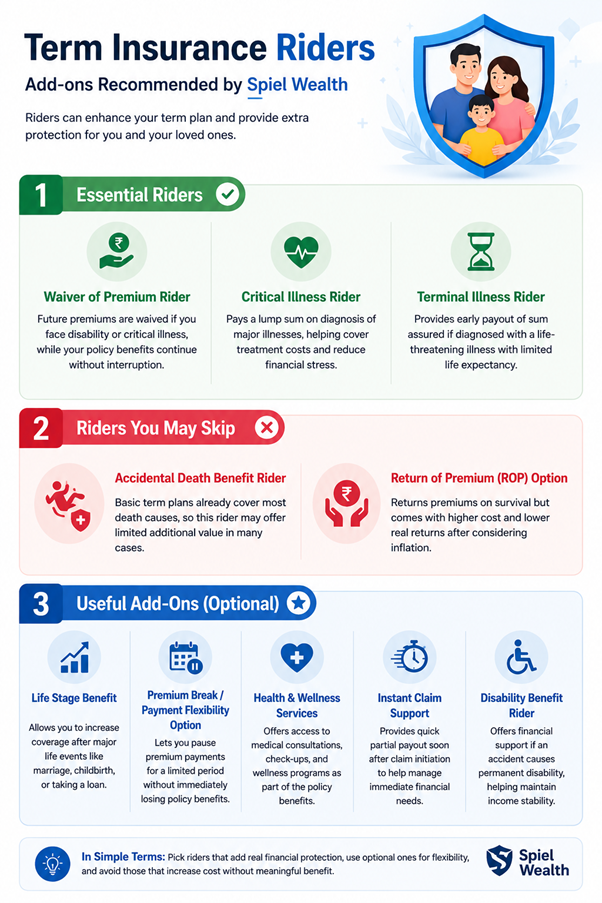
Premium usually remains constant throughout the policy term. - Rider Benefits
Additional protection can be added through riders like critical illness or accidental death. - Tax Benefits
Premiums and payouts may qualify for tax benefits under applicable laws. - Simple and Transparent
Easy to understand with clear terms and minimal complexity.
How Term Insurance Functions
- You choose a coverage amount (sum assured), policy term, and premium payment option based on your needs.
- You pay premiums regularly (monthly, quarterly, or yearly) to keep the policy active.
- The premium is decided based on factors like age, health, lifestyle, and coverage amount.
- If the policyholder passes away during the policy term, the insurer pays the sum assured to the nominee.
- The payout can be received as a lump sum, regular income, or a combination, depending on the plan.
- If the policyholder survives the term, no benefit is paid in most basic term plans.
- The policy remains valid only if premiums are paid on time throughout the term.
- Additional riders can be added to enhance coverage for specific risks.
This straightforward structure is what makes term insurance widely regarded as the most basic and protection-focused form of life insurance in comparisons with other life plans.
Different Kinds of Term Insurance Plans in India
- Level Term Insurance
The sum assured remains constant throughout the policy term. It is simple, predictable, and most commonly chosen. - Increasing Term Insurance
The coverage amount increases over time to adjust for inflation and rising financial needs. - Decreasing Term Insurance
The sum assured reduces gradually, usually aligned with decreasing liabilities like home loans. - Return of Premium (TROP) Plan
Returns the total premiums paid if the policyholder survives the term, offering a savings-like benefit. - Convertible Term Insurance
Allows conversion into another life insurance plan later without fresh medical checks. - Renewable Term Insurance
Can be renewed after the term ends without medical re-evaluation, though premiums may increase. - Group Term Insurance
Offered to a group (like employees), providing coverage under a single policy. - Online Term Insurance Plans
Purchased digitally with lower premiums due to reduced administrative costs.
In simple terms:
Different types of term plans are designed to match various needs—whether it’s stable coverage, increasing protection, or added flexibility.
Who is Term Insurance Best Suited For?
Term insurance is ideal for:
- Working professionals with a regular or irregular income
- Individuals managing financial obligations like EMIs or debts
- Guardians responsible for children’s future needs
- Entrepreneurs handling business and personal responsibilities
- Anyone whose dependents rely on their earnings for daily living
In simple terms:
Anyone with financial responsibilities or dependents should consider term insurance to protect their family’s future.
Benefits and Limitations of Term Insurance
| Advantages | Disadvantages |
| High coverage at affordable premium | No maturity benefit in basic plans |
| Provides financial security to family | No savings or investment component |
| Simple and easy to understand | Coverage ends after policy term |
| Flexible policy term options | Premium increases with age if bought late |
| Option to add riders for extra protection | Claim may be rejected if details are misreported |
| Helps cover loans and liabilities | No returns if policyholder survives (basic plan) |
| Tax benefits under applicable laws | Requires regular premium payment to stay active |
What is Life Insurance?
Life insurance is a wide category of policies designed to provide financial support to your family in case of your death, while some plans also help in building savings over time.
In simple terms, it is an agreement between you and the insurer where you pay regular premiums, and in return, the insurer pays a fixed amount to your nominee if something happens to you. In certain plans, you may also receive a payout if you survive the policy term.
In India, life insurance products are broadly classified into two main categories:
- Pure Protection Plans
These plans focus only on providing life cover. They offer a high sum assured at a low premium but do not include any savings or investment component. Term insurance is the most common example. - Savings and Investment Plans
These plans combine life cover with savings or investment benefits. They help in wealth creation or capital protection along with insurance coverage. Examples include endowment plans, money-back plans, and ULIPs.
This basic structure highlights how life insurance policies are designed and why they differ from term insurance. Most life insurance plans are built around these key components:
- Insured Individual
The person whose life is covered under the policy. - Policy Owner
The individual who purchases the policy and is responsible for paying the premiums. - Beneficiary
The person(s) who receive the policy benefits in case of the insured’s death. - Coverage Amount
The fixed sum that the insurer promises to pay as per the policy terms. - Coverage Duration
The time period for which the policy remains active and provides protection. - Premium Payment
The amount paid regularly to maintain the policy benefits. - Death Claim Amount
The payout made to beneficiaries if the insured passes away during the policy period. - Survival Benefit (if applicable)
The amount paid to the policyholder if they outlive the policy term, depending on the plan type.
How Life Insurance Policies Function
- You choose a policy based on your financial goals, coverage needs, and duration.
- You pay premiums regularly (monthly, quarterly, or yearly) to keep the policy active.
- A part of the premium goes towards life cover, while in some plans, the remaining is invested or saved.
- The insurer provides coverage for the chosen policy term or even for whole life, depending on the plan.
- If the policyholder passes away during the policy period, the nominee receives the death benefit.
- If the policyholder survives the term, certain plans provide a maturity or survival benefit.
- Some policies may also offer bonuses or returns based on performance or profits.
- The policy remains valid only if premiums are paid on time and all terms are followed.
In simple terms:
Life insurance works by combining financial protection with savings or investment benefits, ensuring support for your family or returns for you over time.
Different Kinds of Life Insurance Plans
- Term Insurance Plan
This is the simplest form of life insurance that offers pure risk coverage for a fixed period. It provides a high sum assured at a low premium. If the policyholder passes away during the term, the nominee receives the payout, but there is usually no maturity benefit. - Whole Life Insurance Plan
This plan provides coverage for the entire lifetime, usually up to 99 or 100 years. It ensures that the nominee will receive the benefit whenever the policyholder passes away. Some plans also include a savings or cash value component. - Endowment Plan
Endowment plans combine life cover with savings. If the policyholder survives the term, they receive a lump sum amount. In case of death during the policy period, the nominee gets the sum assured. These plans may also offer bonuses. - Money-Back Plan
These plans provide periodic payouts at regular intervals during the policy term. Along with survival benefits, they also offer life cover. Even if payouts have already been made, the full sum assured is paid to the nominee in case of death. - Child Insurance Plan
These plans are designed to secure a child’s future, especially for education and major life expenses. In case of the parent’s death, the policy continues, and future premiums may be waived while benefits are still provided. - Retirement/Pension Plan
These plans help build a retirement corpus over time. After retirement, they provide regular income (pension). Some plans also include life cover, ensuring financial support for dependents. - Unit Linked Insurance Plan (ULIP)
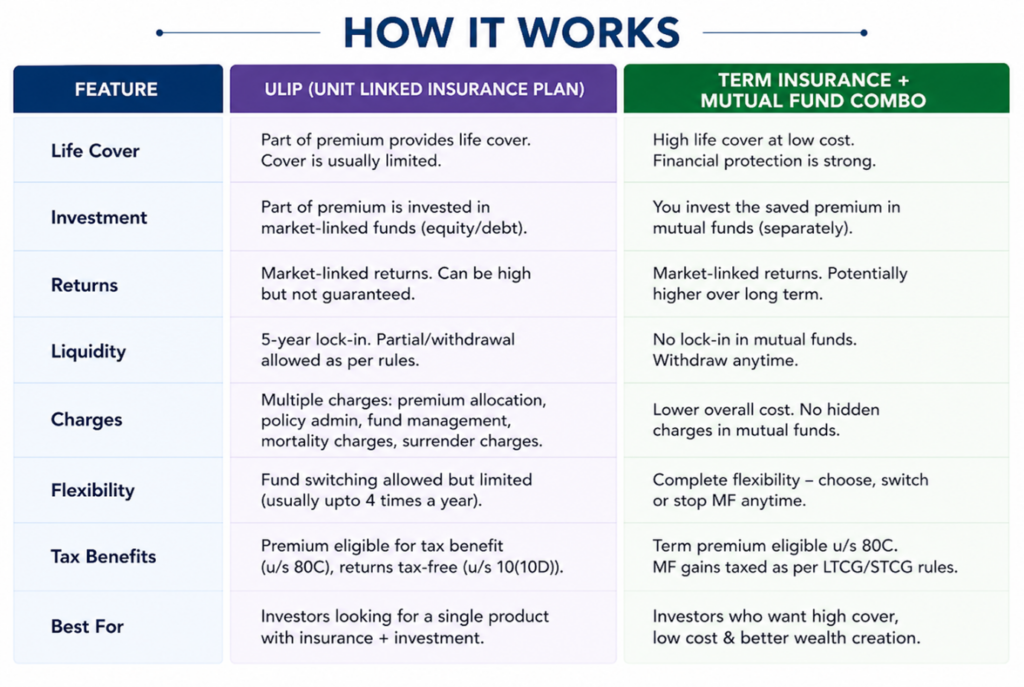
ULIPs combine life insurance with market-linked investments by allocating your premium between risk cover and funds such as equity, debt, or hybrid options. They offer flexibility to switch between funds and come with tax benefits. However, various charges, exposure to market volatility, and a mandatory lock-in period can impact overall returns. For many individuals, separating insurance and investment—by opting for term insurance along with mutual funds—can be a more cost-effective and transparent approa
Who Should Think About Buying Life Insurance?
- Primary Income Earners
Individuals who support their family financially should have life insurance to ensure their dependents remain secure. - Married Individuals
It helps provide financial stability to your spouse and ensures continuity of household expenses. - Parents with Children
Life insurance secures children’s future needs such as education, lifestyle, and major life goals. - Individuals Seeking Savings with Protection
Those who want both life cover and disciplined savings or investment can benefit from such plans. - Self-Employed Individuals
Without fixed income or employer benefits, life insurance helps create financial security for the family. - People Planning Long-Term Goals
Suitable for individuals planning for retirement, wealth creation, or other long-term financial goals. - Individuals with Liabilities
Helps ensure that loans or debts do not become a burden on the family.
In simple terms:
Anyone with financial responsibilities or long-term goals should consider life insurance for both protection and financial planning.
Recommended Term Plans for 2026 by Spiel Wealth
Before we look at the list, here’s how we shortlist plans.
At Spiel Wealth, every term plan is evaluated using a structured approach based on claim reliability, coverage quality, rider flexibility, pricing, and long-term value. These are not the only good plans, but they stand out across key parameters.
| Term Insurance Plan | Coverage & Riders | Claim Settlement Ratio (Avg 2022–25) |
| Max Life Smart Secure Plus | Accidental death benefit, critical illness cover, waiver of premium, life stage benefit, terminal illness cover, flexible payout options | ~99.5%+ |
| HDFC Life Click 2 Protect Super | Accidental death benefit, critical illness rider, waiver of premium, life stage increase option, terminal illness benefit, income payout option | ~99.5%+ |
| ICICI Pru iProtect Smart | Life stage benefit, accidental death cover, critical illness rider, terminal illness payout, flexible payout structure | ~98–99% |
| Bajaj Allianz Smart Protect Goal | Accidental death benefit, critical illness cover, waiver of premium, life stage enhancement, terminal illness cover | ~99% |
| Tata AIA Sampoorna Raksha Supreme | Whole life coverage, critical illness rider, income benefit option, waiver of premium, terminal illness cover | ~98–99% |
| Aditya Birla Sun Life DigiShield Plan | Critical illness benefit, terminal illness payout, waiver of premium on disability, flexible coverage options, limited premium payment | ~98%+ |
In simple terms:
Spiel Wealth recommends plans that balance high claim reliability, strong features, and real-world usability, so your family faces no issues when it matters most.
Why Spiel Wealth is the Right Choice for Your Term Insurance Needs
Spiel Wealth helps you make informed and confident decisions when selecting a term insurance plan. Instead of promoting random policies, it focuses on understanding your financial goals, responsibilities, and long-term needs. Based on this, it compares multiple top insurers and suggests plans that offer the right balance of high coverage, strong claim history, and affordability.
With a clear and transparent approach, Spiel Wealth ensures you understand every detail of your policy—features, benefits, and exclusions—so there are no surprises later. The goal is to simplify insurance for you and help you choose a plan that truly protects your family’s future.
You can also book a FREE consultation. Slots are limited, so make sure to book a call or WhatsApp us now!
Final Thoughts
Term insurance and life insurance both play an important role in financial planning, but their purpose is different. Term insurance focuses on providing high financial protection at an affordable cost, while life insurance combines protection with savings or investment benefits.
The right choice depends on your financial goals, responsibilities, and life stage. If your priority is securing your family’s future with maximum coverage, term insurance is often the most efficient option. If you are also looking for savings or wealth creation, life insurance plans may be more suitable.
In simple terms, the best approach is to understand your needs first and then choose the plan that offers the right balance of protection and benefits.