
What is Senior Citizen Health Insurance?
Senior Citizen Health Insurance is a health insurance policy specially designed for individuals aged 60 years and above. It provides financial protection against medical expenses that may arise due to age-related illnesses, hospitalization, surgeries, and other healthcare needs.
These plans are tailored to address the higher healthcare requirements of senior citizens by covering eligible expenses such as hospitalization, day-care procedures, pre- and post-hospitalization costs, ambulance services, and cashless treatment at network hospitals, subject to the policy terms and conditions.
As healthcare costs continue to rise with age, a senior citizen health insurance plan helps reduce the financial burden of medical treatment while ensuring access to quality healthcare. Choosing the right plan can provide peace of mind and support better health management during the retirement years.
Why Health Insurance is Essential After the Age of 60
After the age of 60, the risk of health issues and medical emergencies increases, making healthcare more expensive. A Senior Citizen Health Insurance plan helps cover eligible expenses such as hospitalization, surgeries, day-care treatments, ambulance services, and cashless treatment at network hospitals, as per the policy terms.
Having health insurance helps protect retirement savings from unexpected medical costs and ensures timely access to quality healthcare. It provides financial security and peace of mind, allowing senior citizens to focus on their health rather than treatment expenses.
Who is Eligible for Senior Citizen Health Insurance?
Senior Citizen Health Insurance is primarily designed for individuals aged 60 years and above. However, the minimum and maximum entry age may vary depending on the insurer and the specific policy. Some plans also allow lifelong renewability, enabling policyholders to continue their coverage without age-related restrictions.
Eligibility is generally based on factors such as age, medical history, and the insurer’s underwriting guidelines. In some cases, applicants may be required to undergo a medical examination before the policy is issued.
Eligibility at a Glance
| Criteria | Details |
| Age | Generally 60 years and above |
| Medical Evaluation | May be required depending on the insurer and health condition |
| Pre-Existing Diseases | Covered after the applicable waiting period, as per policy terms |
| Renewability | Many plans offer lifetime renewal |
| Eligibility Conditions | Subject to the insurer’s terms, policy rules, and underwriting guidelines |
Before purchasing a policy, always review the insurer’s eligibility criteria, waiting periods, and coverage conditions to choose a plan that best suits your healthcare needs.
Key Features to Look for in a Senior Citizen Health Insurance Plan
Choosing the right Senior Citizen Health Insurance Plan requires careful evaluation of its features. A good policy should provide comprehensive medical coverage while ensuring easy access to quality healthcare and financial protection during retirement.
- Adequate Sum Insured – Choose a coverage amount that can handle increasing medical and hospitalization expenses.
- Coverage for Pre-Existing Diseases – Check the waiting period and policy terms for covering existing health conditions.
- Comprehensive Hospitalization Cover – Ensure the plan includes hospitalization, surgeries, ICU charges, and day-care procedures.
- Cashless Treatment Facility – Select a policy with a wide network of hospitals for hassle-free cashless treatment.
- Short Waiting Period – Prefer plans with shorter waiting periods for illnesses and treatments.
- Coverage for Modern Treatments – Check whether the policy covers advanced medical procedures and technologies.
- Annual Health Check-ups – Look for policies that include preventive health check-ups as part of the benefits.
- Lifetime Renewability – Choose a plan that allows renewal throughout your lifetime without age restrictions.
- Co-payment and Sub-limits – Review co-payment clauses, room rent limits, and treatment caps before purchasing.
- Claim Settlement Record – Choose an insurer with a strong claim settlement history and efficient customer support.
- Affordable Premium – Compare premium costs with the coverage and benefits offered to get the best value.
Selecting a plan with these features can help senior citizens receive better healthcare coverage while reducing financial stress during medical emergencies.
What Does Senior Citizen Health Insurance Cover? (Inclusions & Exclusions)
A Senior Citizen Health Insurance Plan is designed to provide financial protection against medical expenses that become more common with age. While coverage varies by insurer, understanding both the inclusions and exclusions helps you choose the right policy and avoid surprises during claims.
Inclusions
| Coverage | Description |
| Hospitalization Expenses | Covers eligible expenses for in-patient treatment and hospitalization. |
| Day-Care Procedures | Covers treatments that do not require 24-hour hospitalization. |
| Pre- & Post-Hospitalization | Covers eligible medical expenses before and after hospitalization for the specified period. |
| ICU & Surgical Expenses | Covers intensive care charges and eligible surgical procedures. |
| Emergency Ambulance | Covers ambulance expenses up to the policy limit. |
| Cashless Treatment | Available at network hospitals, subject to policy terms. |
| Annual Health Check-ups | Many plans provide preventive health check-ups after a specified period. |
| Modern Treatments | Some policies cover advanced medical treatments and procedures. |
Exclusions
| Not Covered | Description |
| Waiting Period Conditions | Certain illnesses and pre-existing diseases are covered only after the applicable waiting period. |
| Cosmetic Treatments | Procedures performed only for cosmetic or aesthetic reasons are generally excluded. |
| Non-Medical Expenses | Items such as toiletries, registration fees, and other non-medical charges are usually not covered. |
| Self-Inflicted Injuries | Treatment for intentional self-harm is generally excluded. |
| Experimental Treatments | Treatments not recognized under the policy terms may not be covered. |
| Policy-Specific Exclusions | Certain diseases, treatments, or conditions may be excluded depending on the insurer and policy. |
Before purchasing a senior citizen health insurance plan, carefully review the policy wording to understand what is covered, what is excluded, and the applicable waiting periods. This helps ensure smoother claim processing and better financial protection during medical emergencies.
How to Choose the Best Senior Citizen Health Insurance Plan
Choosing the right Senior Citizen Health Insurance Plan is essential to ensure quality healthcare and financial security during retirement. Instead of selecting a policy based only on the premium, compare its coverage, benefits, and claim features to find the one that best suits your healthcare needs.
- Choose an Adequate Sum Insured – Select a coverage amount that can handle rising medical and hospitalization expenses.
- Check Coverage for Pre-Existing Diseases – Review the waiting period and policy terms for existing medical conditions.
- Compare Coverage Benefits – Ensure the policy covers hospitalization, day-care procedures, surgeries, ambulance charges, and pre- & post-hospitalization expenses.
- Look for a Wide Hospital Network – Choose an insurer with a large network of hospitals for convenient cashless treatment.
- Review Waiting Periods – Compare waiting periods for pre-existing diseases and specific illnesses before purchasing.
- Check Co-payment and Sub-limits – Understand room rent limits, co-payment clauses, and treatment caps that may affect your claim amount.
- Evaluate the Claim Settlement Record – Select an insurer known for a high claim settlement ratio and efficient claim support.
- Look for Lifetime Renewability – Prefer a policy that offers continuous renewal without age restrictions.
- Compare Premium and Benefits – Choose a plan that provides the best balance between affordability and comprehensive coverage.
By comparing these factors carefully, you can select a senior citizen health insurance plan that offers reliable medical coverage, smooth claim support, and long-term financial protection.
Senior Citizen Health Insurance Plans in India: A Detailed Comparison
Choosing the right senior citizen health insurance plan requires comparing more than just the premium. Factors such as coverage, waiting periods, claim settlement support, co-payment clauses, and hospital network play a crucial role in selecting the most suitable policy. The comparison below highlights some of the popular insurers in India and their key features. Since policy features may change over time, always verify the latest details before purchasing.
| Insurance Company | Popular Plan | Entry Age | Cashless Network Hospitals | Pre-Existing Disease Waiting Period* | Key Highlights |
| Niva Bupa | Senior First | 60+ Years | 10,000+ | 2–3 Years | High coverage options, modern treatments, wellness benefits |
| Care Health Insurance | Care Senior | 61+ Years | 11,400+ | 3 Years | Annual health check-ups, cashless hospitalization, optional add-ons |
| ICICI Lombard | Health Advantage | 60+ Years | 9,500+ | 3 Years | Comprehensive hospitalization cover and restoration benefit |
| HDFC ERGO | Optima Secure | Adults including Seniors | 13,000+ | 3 Years | Secure benefit, restore benefit, large hospital network |
| Aditya Birla Health Insurance | Active Care | 55+ Years | 11,000+ | 3 Years | Chronic care support, wellness rewards, health management programs |
Waiting periods, entry age, coverage, and benefits vary by insurer, plan selected, and policy terms.
Factors to Compare Before Choosing
- Sum insured and overall coverage.
- Coverage for pre-existing diseases and waiting period.
- Cashless hospital network in your city.
- Co-payment and room rent limits.
- Claim settlement support and customer service.
- Premium vs. benefits offered.
- Lifetime renewability and optional add-on covers.
Comparing these factors instead of choosing a plan based only on premium can help you find a senior citizen health insurance policy that offers comprehensive protection, better claim support, and long-term financial security.
Comparing Premium Costs and Ways to Reduce Health Insurance Premiums
Health insurance premiums for senior citizens generally increase with age because the likelihood of medical treatment and hospitalization also rises. However, the premium depends on several factors such as age, sum insured, city, medical history, policy benefits, and the insurer’s underwriting guidelines. Comparing plans from different insurers helps you choose the best balance between cost and coverage.
Approximate Premium Comparison (₹10 Lakh Sum Insured, Individual Senior Citizen)
| Age Group | Star Health | Niva Bupa | Care Health | HDFC ERGO | ICICI Lombard |
| 60–65 Years | ₹18,000–₹28,000 | ₹19,000–₹30,000 | ₹18,500–₹29,000 | ₹20,000–₹31,000 | ₹21,000–₹32,000 |
| 66–70 Years | ₹25,000–₹38,000 | ₹26,000–₹40,000 | ₹25,500–₹39,000 | ₹27,000–₹42,000 | ₹28,000–₹43,000 |
| 71–75 Years | ₹34,000–₹50,000 | ₹35,000–₹52,000 | ₹34,500–₹51,000 | ₹36,000–₹54,000 | ₹37,000–₹55,000 |
| 76+ Years | ₹45,000+ | ₹46,000+ | ₹45,000+ | ₹48,000+ | ₹49,000+ |
Note: Premiums are indicative and may vary based on medical history, city, GST, optional add-ons, underwriting, and policy benefits.
Ways to Reduce Health Insurance Premiums
- Compare multiple insurers before purchasing instead of choosing the first available plan.
- Select the right sum insured based on your healthcare needs rather than opting for unnecessary coverage.
- Choose a higher deductible with a Super Top-Up Plan to lower the base policy premium.
- Buy health insurance early, as premiums are generally lower at younger ages.
- Maintain a healthy lifestyle, as some insurers reward healthy habits through wellness programs.
- Avoid unnecessary add-on covers and choose only those that match your healthcare needs.
- Renew your policy on time to maintain continuity benefits and avoid policy lapses.
- Look for No Claim Bonus (NCB) benefits that increase coverage without significantly increasing premiums.
- Choose annual premium payments, which may be more economical than shorter payment frequencies with some insurers.
Comparing premiums along with coverage, claim settlement record, hospital network, and policy benefits will help you select a senior citizen health insurance plan that provides the best value for your money.
Cashless Treatment for Senior Citizens: How It Works
Cashless treatment allows senior citizens to receive medical care at network hospitals without paying the entire hospitalization bill upfront. Instead, the insurance company settles the eligible expenses directly with the hospital, making the treatment process more convenient during medical emergencies.
To avail this facility, the policyholder must visit a network hospital and present their health insurance card along with a valid identity proof. The hospital then sends a cashless claim request to the insurer or Third-Party Administrator (TPA) for approval. Once the claim is approved, the insurer directly pays the covered medical expenses to the hospital, while the policyholder is responsible only for expenses that are not covered under the policy, if any.
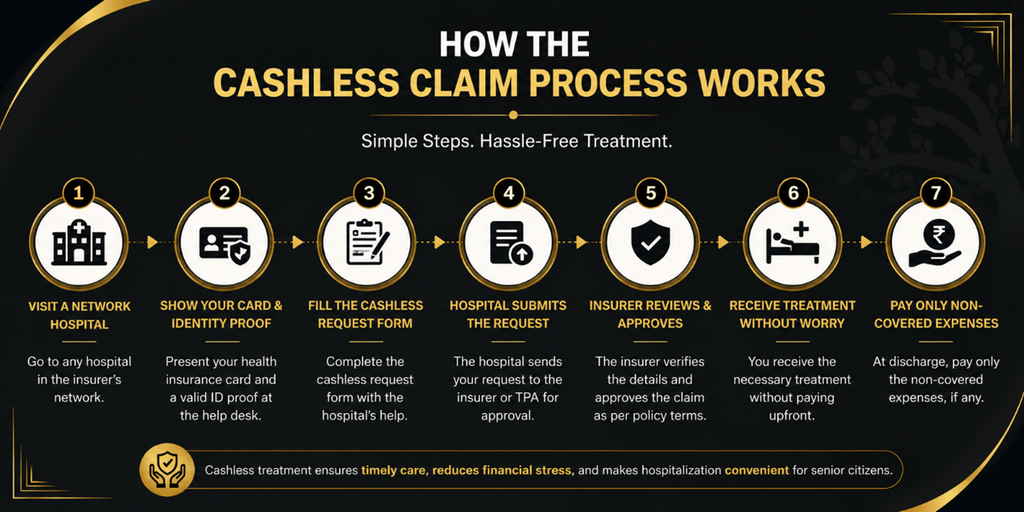
Using the cashless treatment facility helps senior citizens receive timely medical care with minimal financial stress, making hospitalization smoother and more convenient.
Government Health Insurance Schemes for Senior Citizens in India
The Government of India offers several health insurance and healthcare schemes to help senior citizens access affordable medical treatment. These schemes aim to reduce the financial burden of hospitalization and ensure that eligible elderly individuals receive quality healthcare. Eligibility, benefits, and coverage vary from one scheme to another, so it is important to check the latest guidelines before applying.
| Scheme | Who Can Apply? | Key Benefits |
| Ayushman Bharat – Pradhan Mantri Jan Arogya Yojana (PM-JAY) | Eligible economically weaker families as per government criteria | Cashless hospitalization up to the prescribed limit at empanelled hospitals. |
| Ayushman Vay Vandana Scheme | Eligible senior citizens under the notified government guidelines | Health coverage and cashless treatment benefits through empanelled hospitals, subject to scheme rules. |
| Central Government Health Scheme (CGHS) | Central Government employees, pensioners, and eligible dependents | OPD consultation, medicines, diagnostic tests, hospitalization, and specialist treatment. |
| Employees’ State Insurance (ESI) | Eligible retired insured persons under the ESI scheme | Medical care for eligible retired employees and their spouses, subject to ESI rules. |
| State Government Health Schemes | Eligible residents as per individual state guidelines | Many states provide healthcare assistance and cashless treatment through their own health insurance programs. |
Government health insurance schemes can significantly reduce medical expenses for eligible senior citizens. However, coverage, eligibility criteria, and benefits differ across schemes. Before enrolling, always verify the latest eligibility requirements, covered treatments, participating hospitals, and documentation required through the respective government authority or official scheme portal.
Common Mistakes to Avoid and Reasons for Health Insurance Application Rejection
Applying for health insurance may seem simple, but even small mistakes can lead to delays, higher premiums, or even rejection of your application. Understanding the common reasons for rejection can help you complete the process accurately and improve your chances of getting the right coverage.
Common Mistakes to Avoid
- Providing Incorrect Personal Information – Errors in your name, age, address, or contact details can delay or reject your application.
- Hiding Medical History – Failing to disclose existing illnesses, previous surgeries, or ongoing treatments may lead to application rejection or future claim denial.
- Choosing an Inadequate Sum Insured – Selecting a coverage amount based only on a lower premium may not provide sufficient protection.
- Ignoring Policy Terms – Not reading the waiting periods, exclusions, and eligibility conditions can create problems later.
- Applying Without Comparing Plans – Choosing the first available policy without comparing coverage and benefits may result in an unsuitable plan.
- Submitting Incomplete Documents – Missing identity proof, address proof, age proof, or medical reports can delay the approval process.
Common Reasons for Health Insurance Application Rejection
| Reason | Explanation |
| Incomplete Application Form | Missing or incorrect information can result in rejection. |
| Non-Disclosure of Medical Conditions | Concealing pre-existing diseases or treatments may lead to rejection. |
| Failed Medical Examination | Some insurers may reject applications based on medical underwriting. |
| Incorrect or Fake Documents | Providing invalid or mismatched documents can lead to immediate rejection. |
| Age Eligibility Issues | The applicant may not meet the insurer’s entry-age criteria for the selected plan. |
| High Medical Risk | Certain severe medical conditions may not meet the insurer’s underwriting guidelines. |
| Previous Insurance Fraud or Misrepresentation | Any history of fraudulent claims or false declarations may affect approval. |
Before submitting your application, verify all details, disclose your medical history honestly, and ensure that all required documents are complete and accurate. A carefully completed application not only improves the chances of policy approval but also helps ensure a smooth claim experience in the future.
How to File a Health Insurance Claim for Senior Citizens
Filing a health insurance claim for senior citizens is a simple process when the required steps are followed correctly. Whether it is a cashless claim or a reimbursement claim, submitting the necessary documents on time can help ensure quicker claim settlement and reduce financial stress during hospitalization.
Step 1: Inform the Insurance Company
Notify the insurance company or Third-Party Administrator (TPA) as soon as hospitalization is planned or in case of an emergency.
Step 2: Visit a Network Hospital
For cashless treatment, choose a hospital that is part of the insurer’s network and present the health insurance card along with a valid identity proof.
Step 3: Submit the Required Documents
Provide the claim form, health insurance card, identity proof, doctor’s prescription, hospital records, discharge summary, and medical bills, as required by the insurer.
Step 4: Claim Verification
The insurer reviews the submitted documents and verifies whether the treatment is covered under the policy terms and conditions.
Step 5: Claim Settlement
- Cashless Claim: The insurer directly pays the approved amount to the hospital.
- Reimbursement Claim: The policyholder pays the hospital bill first and later submits the documents to receive reimbursement of eligible expenses.
Tips for Faster Claim Approval
- Inform the insurer without delay.
- Keep all original medical bills and reports safely.
- Ensure the treatment is covered under the policy.
- Submit complete and accurate documents.
- Track the claim status until settlement.
Following these steps can help senior citizens complete the claim process smoothly and receive timely financial assistance during medical emergencies.
Important Factors to Consider Before Buying Senior Citizen Health Insurance
Choosing the right Senior Citizen Health Insurance plan requires careful evaluation of several factors. A well-chosen policy can provide better medical coverage, reduce out-of-pocket expenses, and ensure financial security during medical emergencies.
- Choose an Adequate Sum Insured – Select a coverage amount that can meet rising hospitalization and treatment costs.
- Check Coverage for Pre-Existing Diseases – Review the waiting period and policy terms for existing medical conditions.
- Compare Waiting Periods – Understand waiting periods for pre-existing diseases, specific illnesses, and other benefits before purchasing.
- Review Hospital Network – Prefer insurers with a wide network of hospitals to avail cashless treatment easily.
- Understand Co-payment and Sub-limits – Check whether the policy requires you to pay a percentage of the claim or has room rent limits.
- Compare Premium and Coverage – Don’t choose a plan based only on the lowest premium; compare the overall benefits offered.
- Look for Lifetime Renewability – Select a policy that allows continuous renewal without age restrictions.
- Check Claim Settlement Record – Choose an insurer with a strong claim settlement history and efficient customer support.
- Review Policy Exclusions – Understand treatments, illnesses, or expenses that are not covered under the policy.
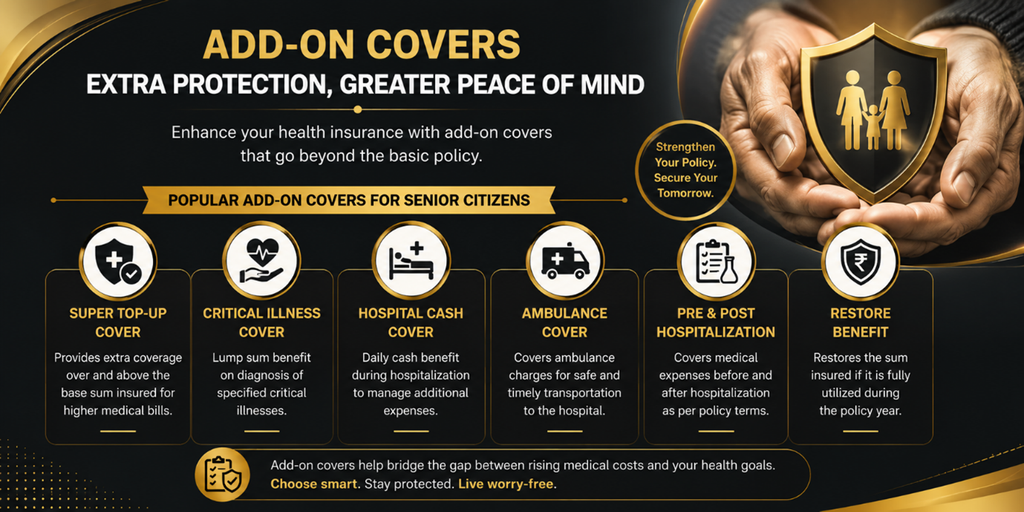
- Consider Optional Add-On Covers – Add benefits like critical illness cover or super top-up plans if they match your healthcare needs.
By comparing these factors carefully, you can choose a senior citizen health insurance plan that offers comprehensive coverage, reliable claim support, and long-term financial protection.