Introduction to Term Insurance for Self-Employed Individuals
Self-employed individuals enjoy the freedom of being their own boss, but this independence also comes with financial uncertainty and irregular income flow. Unlike salaried professionals, they may not have employer-provided life insurance or long-term financial security benefits. This is where term insurance becomes essential. Term insurance is a pure protection plan that provides financial coverage to the family in case of the policyholder’s untimely death during the policy term. For self-employed professionals, it acts as a strong financial safety net, ensuring that their family’s lifestyle, outstanding loans, and future goals remain secure even in their absence. With flexible premium options and high coverage at affordable costs, term insurance is one of the most effective tools for long-term financial protection for self-employed individuals.
Why Self-Employed People Need Term Insurance
Self-employed individuals often face unique financial challenges due to the absence of a fixed monthly salary and employer-provided benefits. Their income may vary depending on business performance, market conditions, or client demand. In such a situation, financial planning becomes even more important to ensure long-term stability for their family.
Term insurance plays a crucial role in providing financial security to self-employed individuals. In the unfortunate event of the policyholder’s untimely death, a term insurance plan ensures that the family receives a lump sum amount. This amount can help cover daily living expenses, repay outstanding debts such as business loans or personal loans, and secure future financial goals like children’s education or spouse’s retirement.
Another important reason self-employed professionals need term insurance is the lack of employer-sponsored benefits like group life insurance or gratuity. Unlike salaried employees, they must independently create their financial safety net. Term insurance offers high coverage at an affordable premium, making it a cost-effective solution for long-term protection.
In addition, it also helps in maintaining business continuity by providing financial support to family members who may need time to manage or stabilize the business after the loss of the earning member.
Overall, term insurance is not just a financial product but a necessity for self-employed individuals to ensure that their responsibilities and family’s future remain protected, no matter what uncertainties arise.
Eligibility Criteria for Self-Employed Term Insurance Plans
· Age Criteria:
Applicants are usually required to be between 18 to 65 years of age. The exact age limits may vary depending on the insurance provider and plan selected.
· Income Proof:
Self-employed individuals need to provide income-related documents such as Income Tax Returns (ITR) for the last 2–3 years, bank statements, or audited financial records to verify earnings.
· Medical Requirements:
Some insurers may require a medical examination or detailed health disclosures. A good health profile can improve approval chances and help in getting better premium rates.
· Identity Proof:
Valid KYC documents such as PAN card, Aadhaar card, passport, or driving license are required for verification.
· Address Proof:
Documents like Aadhaar card, utility bills, or passport may be needed to confirm residential address.
· Financial Stability:
Insurers may evaluate overall financial stability and income consistency to decide the eligible sum assured.
· Coverage Selection:
The chosen term insurance cover should match the applicant’s income level, liabilities, and future financial responsibilities.
These eligibility criteria ensure that self-employed individuals can select a suitable term insurance plan that provides adequate financial protection for their family.
Importance of Income Proof & Financial Stability in Term Insurance for Self-Employed Individuals
Income proof and financial stability are two of the most important factors when applying for a term insurance plan, especially for self-employed individuals. Since their earnings are not fixed like salaried professionals, insurers rely on financial documents to understand their income pattern and risk profile.
· Helps Determine Accurate Coverage:
Income proof such as Income Tax Returns (ITR), bank statements, and financial records help insurers assess the actual earning capacity. This ensures that the sum assured offered is suitable for the applicant’s financial responsibilities.
· Ensures Smooth Policy Approval:
A clear and consistent financial history improves trust with the insurer, making the approval process faster and smoother.
· Reflects Financial Stability:
Stable income records show that the individual can regularly pay premiums without defaulting, which is essential for keeping the policy active in the long run.
· Reduces Chances of Claim Issues:
Proper documentation at the time of purchase helps avoid complications during claim settlement, ensuring the family receives benefits without delays.
· Supports Higher Coverage Eligibility:
Individuals with strong financial stability may be eligible for higher sum assured amounts, providing better protection for their family’s future.
Overall, income proof and financial stability are not just formal requirements—they play a key role in securing the right term insurance coverage and ensuring long-term financial protection.
Key Features of Term Plans for Self-Employed Individuals
Term insurance plans offer essential financial protection, especially for self-employed individuals who do not have employer-provided security benefits. These plans come with several important features designed to provide affordable and high-value coverage.
· High Life Cover at Low Premiums:
Term plans offer a large sum assured at relatively low premium costs, making them an affordable protection option for self-employed individuals.
· Flexible Premium Payment Options:
Policyholders can choose from monthly, quarterly, yearly, or limited pay options based on their cash flow and income pattern.
· Financial Security for Family:
In case of the policyholder’s untimely death, the nominee receives a lump sum amount to manage living expenses, debts, and future financial goals.
· Customizable Policy Terms:
Self-employed individuals can select policy duration based on their age, income stability, and long-term financial responsibilities.
· Tax Benefits:
Premiums paid towards term insurance may be eligible for tax benefits under applicable income tax laws, helping reduce overall tax liability.
· Optional Riders for Extra Protection:
Riders such as critical illness cover, accidental death benefit, or disability cover can be added for enhanced protection.
· No Maturity Benefit (Pure Protection Plan):
Term insurance focuses purely on risk protection, ensuring maximum coverage at minimum cost.
Overall, term plans provide a strong financial safety net for self-employed individuals, ensuring their family remains protected even in uncertain situations.
Benefits of Term Insurance for Self-Employed Professionals
Self-employed professionals often manage unpredictable income and multiple financial responsibilities. In such a situation, term insurance becomes an essential financial tool that offers long-term security and peace of mind.
· Financial Protection for Family:
Term insurance ensures that in case of the policyholder’s untimely death, the family receives a lump sum amount to maintain their standard of living.
· Protection Against Income Uncertainty:
Since self-employed income can fluctuate, term insurance acts as a stable financial backup for the family during difficult times.
· Coverage for Loans and Liabilities:
Outstanding business loans, home loans, or personal debts can be easily managed using the insurance payout, preventing financial burden on family members.
· Affordable High Coverage:
Term insurance provides a high sum assured at relatively low premiums, making it cost-effective even for freelancers and business owners.
· Support for Long-Term Goals:
The payout helps secure future plans like children’s education, marriage expenses, or spouse’s retirement.
· Peace of Mind:
Knowing that their family is financially protected allows self-employed professionals to focus better on their business and growth.
· Flexible Plan Options:
Various policy terms and premium payment modes allow individuals to choose plans based on their income flow and financial situation.
Overall, term insurance is a vital financial safeguard for self-employed professionals, ensuring stability and protection in uncertain situations.
Required Documents for Self-Employed Term Insurance
Self-employed individuals need to submit certain essential documents while applying for a term insurance plan. These documents help insurers verify identity, income, and financial stability before approving the policy.
· Identity Proof (KYC Documents):
PAN card, Aadhaar card, passport, or driving license are commonly accepted for identity verification.
· Address Proof:
Documents such as Aadhaar card, passport, utility bills, or rental agreement may be required to confirm residential address.
· Income Proof:
Income Tax Returns (ITR) for the last 2–3 years, bank statements, and audited financial statements (Profit & Loss account, balance sheet) are important to assess income stability.
· Business Proof (if applicable):
GST registration certificate, shop establishment license, or professional practice certificate depending on the type of self-employment.
· Medical Reports:
Depending on the insurer’s requirement, a medical examination report or health declaration may be needed.
· Photographs:
Recent passport-size photographs for application and documentation purposes.
· Additional Financial Documents:
In some cases, insurers may ask for loan statements or investment details to better understand overall financial obligations.
Submitting accurate and complete documents helps ensure a smooth application process and faster policy approval, making it easier for self-employed individuals to secure reliable term insurance coverage.
Medical Tests & Health Requirements for Self-Employed Term Insurance
Medical tests and health requirements are an important part of the term insurance application process, especially for self-employed individuals. Since income may vary, insurers also rely on health evaluation to assess overall risk before approving the policy.
· Basic Health Declaration:
Applicants are required to fill out a medical questionnaire providing details about existing illnesses, past medical history, lifestyle habits, and ongoing treatments.
· Medical Examination (if required):
Depending on age, sum assured, and insurer guidelines, a basic medical test may be required. This can include blood tests, urine tests, blood pressure, sugar level checks, and BMI measurement.
· Lifestyle Assessment:
Habits such as smoking, alcohol consumption, diet, and physical activity may be considered while evaluating risk and deciding premium rates.
· Pre-Existing Diseases Disclosure:
Any existing medical conditions such as diabetes, hypertension, or heart-related issues must be disclosed honestly. Non-disclosure may lead to claim rejection later.
· Age-Based Requirements:
Older applicants are more likely to undergo detailed medical testing compared to younger individuals due to higher risk factors.
· Impact on Premiums:
A healthy medical profile can result in lower premium costs, while higher risk profiles may lead to increased premiums or additional conditions.
· Importance of Transparency:
Providing accurate health information ensures smooth policy approval and avoids complications during claim settlement.
Overall, medical tests and health disclosures help insurers evaluate risk fairly and ensure that self-employed individuals receive the right term insurance coverage based on their health condition.
Factors Affecting Premium for Self-Employed Individuals
The premium of a term insurance plan for self-employed individuals is determined by several important factors. Since their income and risk profile can vary, insurers carefully evaluate multiple aspects before deciding the final premium amount.
· Age of the Applicant:
Age is one of the most important factors. Younger individuals usually get lower premiums, while premiums increase with age due to higher risk.
· Health Condition:
Current health status, medical history, and lifestyle habits such as smoking or alcohol consumption directly impact the premium amount.
· Income and Financial Stability:
Insurers assess income through ITRs, bank statements, and financial records. Higher and stable income may allow eligibility for better coverage options.
· Sum Assured (Coverage Amount):
The higher the insurance coverage chosen, the higher the premium will be.
· Policy Term:
Longer policy durations generally lead to higher total premiums compared to shorter terms.
· Occupation and Risk Level:
The nature of self-employment also matters. High-risk professions may attract higher premiums.
· Medical Test Results:
If medical tests are conducted, the results can influence the premium based on risk assessment.
· Lifestyle Factors:
Daily habits, stress levels, and physical activity are considered during underwriting.
Overall, these factors collectively help insurers decide a fair and balanced premium for self-employed individuals, ensuring appropriate coverage based on their risk profile.
Tax Benefits for Self-Employed Term Insurance
Term insurance not only provides financial protection but also offers valuable tax benefits for self-employed individuals. These tax advantages help reduce overall tax liability while ensuring long-term financial security for the family.
· Tax Deduction on Premium Paid:
Premiums paid towards a term insurance policy are generally eligible for tax deductions under applicable income tax provisions, subject to prescribed limits.
· Benefit for Self-Employed Professionals:
Since self-employed individuals manage their own financial planning, term insurance helps them combine protection with tax-saving opportunities.
· Tax-Free Death Benefit:
The amount received by the nominee in case of the policyholder’s death is generally exempt from tax, providing complete financial support to the family.
· Additional Benefits with Riders:
Premiums paid for certain riders, such as critical illness cover, may also qualify for additional tax benefits depending on applicable tax rules.
· Supports Better Financial Planning:
Tax savings through term insurance allow self-employed individuals to improve cash flow management and invest in other long-term financial goals.
· Encourages Long-Term Protection:
Tax advantages make term insurance more affordable and motivate individuals to maintain continuous life cover.
Overall, term insurance serves as both a financial protection tool and an effective tax-saving option for self-employed individuals, helping them secure their family’s future while managing taxes efficiently.
Riders Available for Self-Employed Term Plans
Riders are optional add-on benefits that enhance the coverage of a term insurance plan. For self-employed individuals, these riders provide extra financial protection against unexpected situations such as critical illness, accidents, or disability. Choosing the right riders can make a term insurance plan more comprehensive and effective.
· Critical Illness Rider:
This rider provides a lump sum payout if the policyholder is diagnosed with specified critical illnesses such as cancer, heart disease, or kidney failure. It helps manage medical expenses and income loss during treatment.
· Accidental Death Benefit Rider:
In case of death due to an accident, an additional payout is provided along with the basic sum assured, offering extra financial support to the family.
· Permanent Disability Rider:
If the policyholder becomes permanently disabled due to an accident and loses earning ability, this rider provides financial assistance as per policy terms.
· Waiver of Premium Rider:
Under certain conditions such as disability or critical illness, future premium payments may be waived while the policy benefits continue.
· Income Benefit Rider:
Instead of a one-time lump sum, this rider provides regular monthly income to the nominee for a fixed period after the policyholder’s death.
· Terminal Illness Rider:
If the insured person is diagnosed with a terminal illness, a portion of the sum assured may be paid in advance to support medical and personal expenses.
· Hospital Cash Rider:
This rider offers a fixed daily cash benefit during hospitalization, helping manage additional medical costs.
Overall, riders help self-employed individuals customize their term insurance plans according to their financial responsibilities and lifestyle risks, ensuring broader protection for themselves and their families.
Common Challenges Faced by Self-Employed Individuals While Buying Insurance
Self-employed individuals often face unique difficulties when purchasing term insurance due to irregular income patterns and the absence of employer-backed financial support. Understanding these challenges can help in making better insurance decisions and preparing the required documents in advance.
· Irregular Income Flow:
Unlike salaried employees, self-employed professionals may have fluctuating monthly income, which can make insurers more cautious during policy approval.
· Difficulty in Providing Income Proof:
Since there are no salary slips, insurers usually require Income Tax Returns (ITR), bank statements, and financial records, which some applicants may not maintain properly.
· Higher Premium Possibility:
Certain professions or unstable financial records may lead insurers to classify applicants as higher risk, resulting in increased premium costs.
· Complex Documentation Process:
Self-employed individuals may need to submit additional documents related to business ownership, GST registration, or financial statements.
· Lower Eligibility for High Coverage:
Inconsistent income or limited financial history may affect eligibility for higher sum assured amounts.
· Medical and Lifestyle Evaluation:
Stressful work schedules, lifestyle habits, or existing health conditions can impact policy approval and premium rates.
· Lack of Financial Awareness:
Many self-employed professionals delay insurance planning due to limited awareness about the importance of life cover and long-term protection.
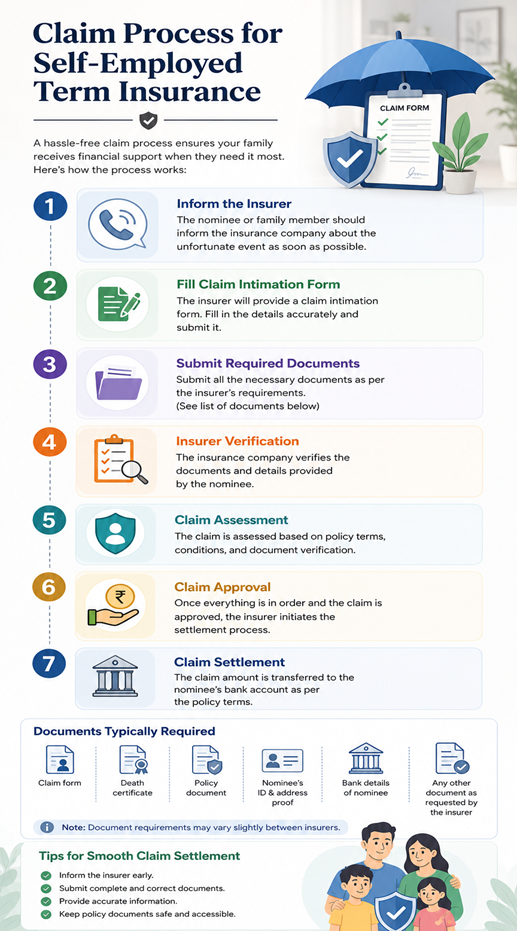
· Claim Settlement Concerns:
Incorrect or incomplete disclosure of income and health details can create complications during claim settlement.
Despite these challenges, choosing the right term insurance plan and maintaining proper financial records can help self-employed individuals secure reliable financial protection for their family’s future.
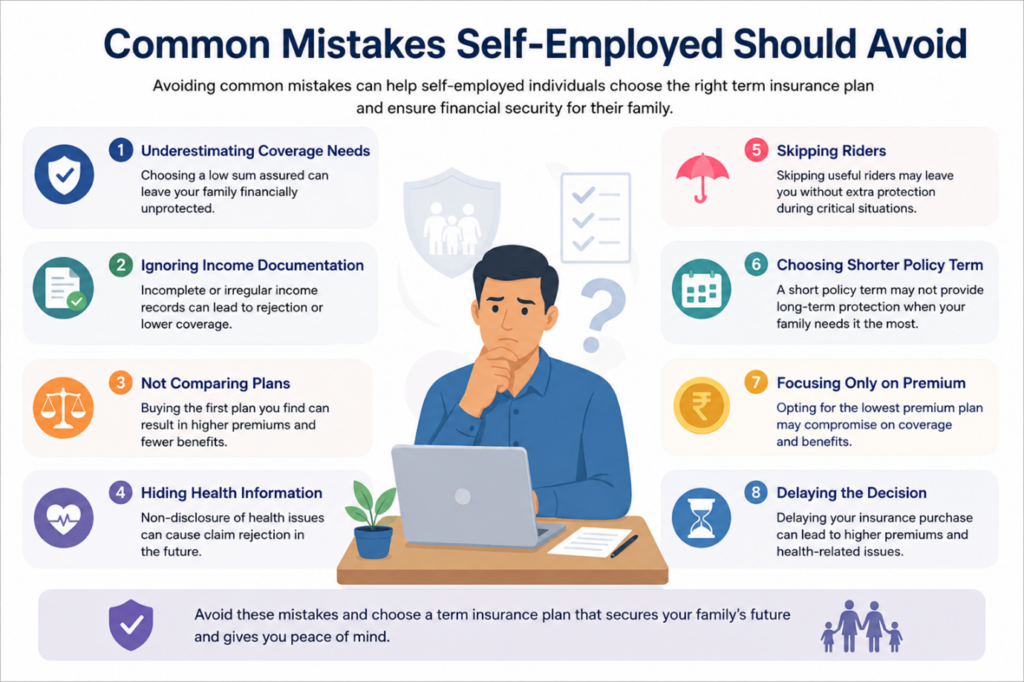
How to Choose the Right Term Plan for Self-Employed Individuals
Choosing the right term insurance plan is extremely important for self-employed individuals because their income and financial responsibilities may change over time. A well-selected term plan provides long-term financial security and protects the family from unexpected financial difficulties.
· Assess Your Financial Responsibilities:
Before choosing a plan, calculate existing liabilities such as home loans, business loans, daily expenses, children’s education, and future family needs.
· Choose Adequate Coverage Amount:
Select a sum assured that can comfortably support your family’s lifestyle and financial goals in your absence.
· Check Income Stability:
Since self-employed income can fluctuate, choose a premium amount that remains affordable even during low-income periods.
· Compare Multiple Insurance Plans:
Comparing different insurers helps in understanding premium costs, benefits, claim settlement record, and additional features.
· Select Suitable Policy Term:
The policy duration should ideally cover your active earning years and major financial responsibilities.
· Consider Important Riders:
Add-ons such as critical illness rider, accidental death benefit, and waiver of premium can provide extra financial protection.
· Review Claim Settlement Ratio:
Choosing an insurer with a strong claim settlement history increases confidence that the family will receive benefits smoothly.
· Disclose Accurate Information:
Provide correct details about income, occupation, lifestyle, and medical history to avoid future claim-related complications.
· Understand Policy Terms Carefully:
Read all terms, exclusions, waiting periods, and conditions before purchasing the policy.
Overall, the right term plan should offer sufficient coverage, affordable premiums, and long-term financial security that matches the unique needs of self-employed individuals.
Final Conclusion
Term insurance is an important financial safety net for self-employed individuals, helping protect their family’s future against income uncertainty, loans, and unexpected life events. Choosing the right coverage with proper financial planning ensures long-term security and peace of mind.
At Spiel Wealth, we help individuals make smarter financial decisions with solutions designed for their long-term protection and stability.