

What is a Family Health Insurance Plan?
A Family Health Insurance Plan, also known as a Family Floater Plan, is a health insurance policy that provides medical coverage for multiple family members under a single policy. Instead of purchasing separate policies for each individual, the entire family shares one common sum insured, making it a convenient and cost-effective option.
A family health insurance plan can typically cover you, your spouse, children, and in some cases, dependent parents, depending on the insurer and the policy selected. If any insured member requires hospitalization or eligible medical treatment, the claim amount is paid from the shared sum insured available under the policy.
These plans generally cover hospitalization expenses, day-care procedures, pre- and post-hospitalization costs, ambulance charges, and cashless treatment at network hospitals, subject to the policy terms and conditions.
A Family Health Insurance Plan is an ideal choice for families looking for comprehensive healthcare protection under a single policy while simplifying policy management and helping safeguard their finances against unexpected medical expenses.
Why Every Family Needs Health Insurance
Healthcare costs are rising every year, and even a single medical emergency can put significant pressure on a family’s finances. A Family Health Insurance Plan helps protect your loved ones by covering eligible medical expenses, allowing you to focus on recovery instead of worrying about hospital bills.
A family health insurance policy offers financial security by providing coverage for hospitalization, surgeries, day-care procedures, pre- and post-hospitalization expenses, and emergency medical treatment under a single plan. It also ensures that every family member has access to quality healthcare when it is needed the most.
Beyond financial protection, a family health insurance plan brings peace of mind. Whether it’s an unexpected illness, an accident, or planned medical treatment, having the right coverage helps safeguard your savings and ensures your family’s healthcare needs are taken care of.
Why It Matters
- Protects your family’s savings from unexpected medical expenses.
- Provides coverage for multiple family members under a single policy.
- Ensures access to quality healthcare during medical emergencies.
- Reduces financial stress caused by rising treatment and hospitalization costs.
Family Floater vs Individual Health Insurance: Which is Better?
Choosing between a Family Floater Health Insurance plan and an Individual Health Insurance plan depends on your family’s healthcare needs, age, budget, and medical history. While both provide financial protection against medical expenses, they differ in how the coverage is structured and utilized.
A Family Floater Plan offers a single sum insured that is shared among all insured family members under one policy. It is generally more economical for young families with fewer medical requirements. In contrast, an Individual Health Insurance Plan provides a separate sum insured for each insured person, ensuring dedicated coverage regardless of whether another family member makes a claim.
The right choice depends on your situation. If your family members are young and healthy, a Family Floater Plan can provide excellent value. However, if family members have different healthcare needs or are older, Individual Health Insurance plans may offer better financial protection.
| Feature | Family Floater Health Insurance | Individual Health Insurance |
| Coverage | One shared sum insured for all members | Separate sum insured for each person |
| Premium | Generally more affordable | Higher, as each person has an individual policy |
| Best For | Young families with fewer health risks | Individuals, senior citizens, or people with existing medical conditions |
| Claim Usage | Claim amount is deducted from the shared sum insured | Each insured person has their own dedicated coverage |
| Policy Management | One policy for the entire family | Separate policy for each insured member |
| Flexibility | Limited by the shared coverage amount | Greater flexibility with individual coverage |
Which One Should You Choose?
- Choose a Family Floater Plan if your family members are young, healthy, and you want cost-effective coverage under one policy.
- Choose Individual Health Insurance if family members have different healthcare needs or require separate and dedicated coverage.
- Compare both options based on your family’s age, medical history, budget, and future healthcare requirements before making a decision.
Who Should Be Covered Under a Family Health Insurance Plan?
A Family Health Insurance Plan is designed to provide medical coverage for multiple family members under a single policy. The members who can be included depend on the insurer and the type of plan selected. Including the right family members ensures that everyone has financial protection against unexpected medical expenses while simplifying policy management.
Typically, a family health insurance plan covers the policyholder, spouse, and dependent children. Many insurers also allow you to include dependent parents, parents-in-law, or newborn babies, depending on the policy terms. Before purchasing a plan, it is important to verify the eligibility criteria, age limits, and relationship requirements specified by the insurer.
| Family Member | Can Be Covered? | Remarks |
| Self (Policyholder) | ✅ Yes | Primary insured person under the policy. |
| Spouse | ✅ Yes | Can be included under the same family floater plan. |
| Dependent Children | ✅ Yes | Usually covered from a specified age until they become financially independent, as per policy terms. |
| Newborn Baby | ✅ In Many Plans | Coverage generally starts after a specified period, depending on the insurer. |
| Dependent Parents | ✅ In Many Plans | Some insurers allow parents to be included, while others offer separate senior citizen plans. |
| Parents-in-law | ✅ In Selected Plans | Available only under certain family health insurance policies. |
How to Choose the Right Sum Insured for Your Family
Choosing the right sum insured is essential to ensure your family is financially protected during medical emergencies. It should be enough to cover hospitalization and treatment costs without putting pressure on your savings.
While selecting the coverage amount, consider factors such as family size, age, existing medical conditions, city of residence, and rising healthcare costs. If your family includes elderly members or you live in a metro city, opting for a higher sum insured can provide better protection.
Choose a sum insured that balances comprehensive coverage and affordability, so your family’s healthcare needs remain well protected both today and in the future.
What Does a Family Health Insurance Plan Cover?
A Family Health Insurance Plan provides financial protection against a wide range of medical expenses for all covered family members under a single policy. While the exact coverage may vary by insurer and policy, most plans generally include the following:
- Hospitalization Expenses – Covers medical costs incurred during hospitalization, including room charges, nursing, and treatment expenses.
- Pre- and Post-Hospitalization Expenses – Pays for eligible medical consultations, diagnostic tests, and medicines before and after hospitalization for a specified period.
- Day-Care Procedures – Covers treatments that do not require 24-hour hospitalization, such as cataract surgery and dialysis.
- Emergency Ambulance Charges – Reimburses or covers ambulance expenses incurred during medical emergencies, subject to policy limits.
- Cashless Treatment – Provides cashless hospitalization at network hospitals, reducing the need for upfront payments.
- ICU and Surgical Expenses – Covers eligible intensive care unit (ICU) charges, surgeries, and operation theatre expenses.
- Maternity and Newborn Cover (If Included) – Some policies offer coverage for maternity-related expenses and newborn baby care after the applicable waiting period.
- Organ Donor Expenses (If Covered) – Covers eligible medical expenses related to organ donation during a transplant, as specified in the policy.
- Annual Health Check-ups – Many plans include preventive health check-ups to help monitor your family’s overall health.
- No Claim Bonus (NCB) – Rewards claim-free years by increasing the sum insured or offering other renewal benefits, depending on the policy.
Key Features to Look for in a Family Health Insurance Policy
Choosing the right family health insurance policy involves more than just comparing premiums. Understanding the key features of a policy helps ensure your entire family receives comprehensive medical and financial protection.
- Adequate Sum Insured – Choose a coverage amount that is sufficient to meet your family’s present and future healthcare expenses.
- Comprehensive Medical Coverage – Ensure the policy covers hospitalization, day-care procedures, pre- and post-hospitalization expenses, and emergency treatments.
- Wide Network of Hospitals – Select an insurer with a large network of hospitals for easy access to cashless treatment.
- Cashless Claim Facility – A smooth cashless claim process can reduce financial stress during medical emergencies.
- Coverage for Pre-Existing Diseases – Check the waiting period and terms for covering existing medical conditions.
- Short Waiting Period – Prefer policies with shorter waiting periods for specific illnesses and pre-existing diseases.
- No Claim Bonus (NCB) – Look for policies that reward claim-free years by increasing the sum insured or offering renewal benefits.
- Lifetime Renewability – Choose a policy that offers lifetime renewal to ensure continuous health coverage.
- Co-payment and Room Rent Limits – Review these conditions carefully, as they can affect your claim amount and out-of-pocket expenses.
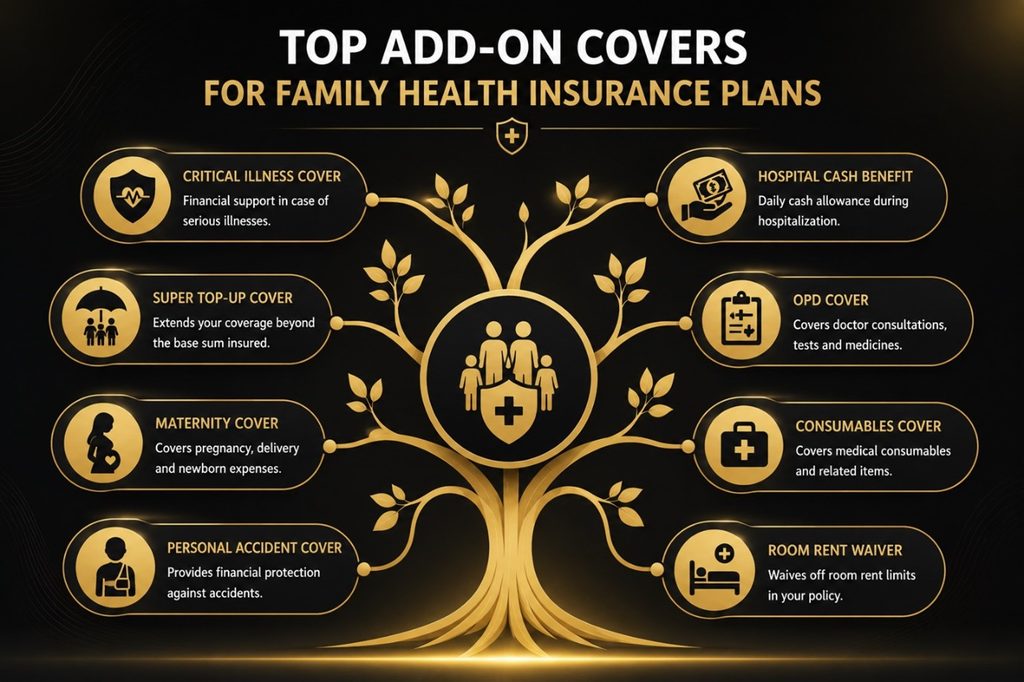
- Optional Add-On Covers – Consider additional benefits such as critical illness cover, maternity cover, personal accident cover, or super top-up plans for enhanced protection.
- Good Claim Settlement Record – Select an insurer with a strong claim settlement history for a faster and more reliable claims experience.
- Affordable Premium with Maximum Benefits – Compare plans to find the right balance between premium cost, coverage, and policy benefits.

How to Compare Family Health Insurance Plans
Choosing the right family health insurance plan requires more than simply comparing premiums. You should evaluate the coverage, benefits, claim process, and policy features to ensure the plan meets your family’s healthcare needs both now and in the future.
| Comparison Factor | What to Check |
| Sum Insured | Ensure the coverage amount is sufficient for your family’s current and future medical expenses. |
| Premium | Compare the premium with the benefits offered instead of selecting the cheapest plan. |
| Coverage Benefits | Check whether the policy covers hospitalization, day-care procedures, pre- and post-hospitalization expenses, ambulance charges, and other essential medical costs. |
| Waiting Period | Compare waiting periods for pre-existing diseases, maternity benefits, and specific treatments. |
| Network Hospitals | Choose a plan with a large network of hospitals for easy access to cashless treatment. |
| Cashless Claim Facility | Verify that the insurer offers a simple and efficient cashless claim process. |
| Policy Exclusions | Review treatments, illnesses, or medical expenses that are not covered under the policy. |
| Co-payment & Room Rent Limit | Check whether the policy includes co-payment clauses or room rent restrictions that may affect claim amounts. |
| Add-On Covers | Compare optional covers such as critical illness, maternity, personal accident, and super top-up benefits. |
| Claim Settlement Record | Consider insurers with a strong claim settlement history and reliable customer support. |
| Renewal Benefits | Check for lifetime renewability, No Claim Bonus (NCB), and other renewal advantages. |
| Customer Support | Evaluate the insurer’s customer service, claim assistance, and overall support experience. |
By comparing these factors instead of focusing only on the premium, you can choose a family health insurance plan that provides comprehensive coverage, better claim support, and long-term financial protection for your loved ones.
If you want 100% original (plagiarism-safe) content for your website, then don’t use exact company descriptions or marketing language. Instead, compare the companies based on publicly available facts in your own words.
Here’s a completely rewritten, SEO-friendly version.
Top Family Health Insurance Companies in India: A Comparison Guide
Choosing a family health insurance policy is not just about finding the lowest premium. The insurer’s hospital network, claim experience, coverage options, and customer support all play an important role in providing long-term financial protection for your family. Comparing different insurance companies helps you identify the policy that best matches your healthcare requirements.
The table below provides a general comparison of some of India’s leading health insurance providers. The information is intended to help you understand the strengths of each insurer before making a decision.
| Insurance Company | Approx. Cashless Hospitals | Suitable For | Key Highlights |
| HDFC ERGO | 16,000+ | Families looking for comprehensive protection | Wide hospital network, flexible family plans, digital claim support |
| Niva Bupa | 10,000+ | Young families | High restoration benefits, modern healthcare features |
| Care Health Insurance | 19,000+ | Large families | High sum insured options and extensive hospital network |
| Star Health Insurance | 14,000+ | Families of all sizes | Multiple family floater plans with broad coverage choices |
| Aditya Birla Health Insurance | 11,000+ | Wellness-focused families | Preventive healthcare and wellness reward programs |
| ICICI Lombard | 9,500+ | Working professionals | Flexible policy options and comprehensive coverage |
| Bajaj Allianz | 18,000+ | Families seeking balanced coverage | Large hospital network with multiple add-on options |
| SBI General Insurance | 16,000+ | Budget-conscious families | Affordable premiums with essential health benefits |
| Tata AIG | 11,500+ | Families seeking premium coverage | Higher coverage options and quality healthcare support |
| New India Assurance | 8,000+ | Families preferring a public sector insurer | Government-backed insurer with long market presence |
Note: Hospital network size, premiums, policy features, and claim-related information may change over time. Always verify the latest details directly with the insurer before purchasing a health insurance policy.
Common Mistakes to Avoid When Buying Family Health Insurance
Buying a family health insurance plan is an important financial decision, but many people focus only on the premium and overlook other essential factors. Avoiding these common mistakes can help you choose a policy that provides better protection for your entire family.
- Choosing an Inadequate Sum Insured – Selecting a low coverage amount may leave you paying significant medical expenses from your own pocket.
- Buying Based Only on Low Premium – A cheaper policy may offer limited coverage, higher restrictions, or fewer benefits.
- Ignoring Policy Exclusions – Always read the policy carefully to understand which treatments and medical expenses are not covered.
- Not Checking Waiting Periods – Review waiting periods for pre-existing diseases, maternity benefits, and specific treatments before purchasing.
- Overlooking Network Hospitals – Ensure your preferred hospitals are included in the insurer’s cashless network.
- Hiding Medical Information – Always disclose accurate medical history to avoid claim rejection in the future.
- Ignoring Co-payment and Room Rent Limits – These conditions can increase your out-of-pocket expenses during hospitalization.
- Not Comparing Multiple Plans – Compare different insurers based on coverage, claim settlement record, benefits, and premium before making a decision.
- Ignoring Add-On Covers – Optional covers like critical illness or super top-up plans can provide valuable additional protection.
- Not Reviewing the Policy Regularly – As your family grows and healthcare costs increase, review your policy to ensure it still meets your family’s needs.
Avoiding these mistakes can help you select a family health insurance plan that offers comprehensive coverage, smoother claim experience, and long-term financial security.
How to File a Health Insurance Claim for Your Family
Filing a health insurance claim for your family is a straightforward process when you understand the required steps. Whether you choose a cashless claim or a reimbursement claim, keeping the necessary documents ready and following the insurer’s guidelines can help ensure faster claim settlement.
Step 1: Inform the Insurance Company
As soon as hospitalization is planned or occurs in an emergency, notify your insurer or Third-Party Administrator (TPA) within the required timeline.
Step 2: Choose a Network Hospital (For Cashless Claims)
If possible, get treatment at a network hospital to avail the cashless claim facility. Present your health insurance card and a valid identity proof at the hospital.
Step 3: Submit the Required Documents
Provide the necessary documents such as the health insurance card, identity proof, doctor’s prescription, hospital records, and claim form. Keep copies of all reports and bills for future reference.
Step 4: Claim Verification
The insurer reviews the submitted documents, verifies policy coverage, and confirms whether the treatment is eligible under the policy terms.
Step 5: Claim Settlement
- Cashless Claim: The insurer directly settles the approved amount with the hospital, and you only pay expenses that are not covered, if applicable.
- Reimbursement Claim: You pay the hospital bill first and then submit the original documents to the insurer for reimbursement of eligible expenses.
Tips for a Smooth Claim Process
- Inform the insurer as early as possible.
- Keep all original medical bills and hospital documents safe.
- Ensure the treatment is covered under your policy.
- Fill the claim form accurately and submit all required documents.
- Track your claim status until it is successfully settled.
Following these steps can make the health insurance claim process easier and help your family receive financial support without unnecessary delays during medical emergencies.
Top Add-On Covers for Family Health Insurance Plans
How to Review and Upgrade Your Family Health Insurance Plan Over Time
A Family Health Insurance Plan should be reviewed regularly to ensure it continues to meet your family’s changing healthcare needs. As your family grows, medical costs increase, and health requirements change, your existing coverage may no longer be sufficient.
Review your policy at the time of renewal and check important factors such as sum insured, coverage benefits, exclusions, waiting periods, network hospitals, and premium changes. Major life events like marriage, the birth of a child, adding dependent parents, or changes in health conditions may require an upgrade in your coverage.
Upgrading your health insurance plan at the right time helps you stay prepared for rising medical expenses and ensures your family receives adequate financial protection during emergencies.
Key Points to Review
- Check if your sum insured is still sufficient considering rising healthcare costs.
- Update your policy after major life changes like marriage, childbirth, or adding family members.
- Review coverage benefits to identify any gaps in your existing plan.
- Consider add-on covers for additional protection based on your family’s needs.
- Compare new plans and upgrades before renewal for better benefits.
- Ensure continuous renewal to maintain uninterrupted health coverage.