
Understanding Health Insurance Before You Buy
Buying health insurance is an important step toward protecting yourself and your family from unexpected medical expenses. Before purchasing a policy, it is essential to understand how health insurance works, what it covers, and the benefits it provides. A clear understanding of these basics helps you choose a plan that matches your healthcare needs and financial goals.
You should also evaluate key factors such as the sum insured, policy coverage, exclusions, waiting periods, network hospitals, claim process, and premium. Comparing these features across different plans allows you to make an informed decision rather than choosing a policy based only on price.
Taking the time to understand health insurance before buying ensures you invest in a policy that offers comprehensive protection, supports your long-term financial well-being, and provides peace of mind during medical emergencies.
Different Types of Health Insurance Plans
Health insurance plans are available in different types to meet the healthcare needs of individuals, families, senior citizens, and people with specific medical requirements. Understanding these options helps you choose a policy that offers the right level of protection and financial security.
Individual Health Insurance covers a single person, with the entire sum insured dedicated to that individual. It is suitable for people who want personalized health coverage.
Family Floater Health Insurance covers multiple family members under one policy with a shared sum insured. It is a cost-effective option for families looking for comprehensive protection.
Senior Citizen Health Insurance is specially designed for individuals aged 60 years and above. These plans focus on age-related healthcare needs and hospitalization expenses.
Critical Illness Insurance provides a lump sum benefit if the insured is diagnosed with specified critical illnesses, such as cancer, heart attack, or stroke, helping manage treatment and recovery costs.
Group Health Insurance is generally offered by employers to employees and may also cover their dependents. It provides basic health coverage at a lower cost but may not always be sufficient for long-term needs.
Top-Up and Super Top-Up Plans offer additional coverage once a specified deductible is crossed. They are an affordable way to increase your overall health insurance protection.
Choosing the right type of health insurance depends on your age, family size, medical history, healthcare requirements, and budget. Comparing different plans before making a decision helps ensure you select a policy that provides comprehensive coverage and long-term financial protection.
Individual vs Family Floater: Which Plan Fits Your Needs?
Choosing between an Individual Health Insurance plan and a Family Floater Health Insurance plan depends on your age, family size, healthcare needs, and budget. Both plans provide financial protection against medical expenses, but they differ in the way coverage is offered and utilized.
An Individual Health Insurance plan provides a separate sum insured for each insured person. This means the entire coverage is reserved for one individual, making it a suitable choice for people with higher healthcare needs, senior citizens, or those who prefer dedicated coverage.
A Family Floater Health Insurance plan, on the other hand, covers multiple family members under a single policy with a shared sum insured. It is generally more cost-effective and works well for young families where all members are relatively healthy and less likely to require hospitalization at the same time.
If you are buying insurance only for yourself or have specific medical requirements, an Individual Health Insurance plan may be the better option. However, if you want affordable coverage for your spouse, children, or parents under one policy, a Family Floater plan can offer greater convenience and value.
The right choice depends on your family’s healthcare needs, financial goals, and the level of coverage required. Comparing both options carefully before purchasing helps ensure you select a health insurance plan that provides the best long-term protection.
How to Decide the Right Sum Insured?
The sum insured is the maximum amount your health insurance policy will cover for eligible medical expenses in a policy year. Choosing the right sum insured ensures you have adequate financial protection during hospitalization or medical emergencies.
Consider factors such as your age, family size, city of residence, lifestyle, medical history, and rising healthcare costs when selecting the coverage amount. A higher sum insured can help protect your savings from expensive treatments and unexpected medical expenses.
Choosing a sum insured that balances your healthcare needs and budget will provide better long-term financial security and peace of mind.
Essential Features to Check Before Buying Health Insurance
Choosing the right health insurance policy involves more than just comparing premiums. Reviewing the essential features before making a purchase helps you select a plan that offers comprehensive coverage, smooth claim support, and long-term financial protection.
- Adequate Sum Insured – Choose a coverage amount that can comfortably handle hospitalization and rising medical expenses.
- Policy Coverage – Check whether the policy covers hospitalization, day-care procedures, pre- and post-hospitalization expenses, ambulance charges, and other essential medical costs.
- Waiting Period – Review the waiting periods for pre-existing diseases, specific illnesses, and maternity benefits before purchasing the policy.
- Network Hospitals – Ensure the insurer has a wide network of hospitals so you can easily avail cashless treatment when required.
- Cashless Claim Facility – Verify that the insurer offers a smooth cashless claim process at network hospitals for hassle-free hospitalization.
- Policy Exclusions – Understand which treatments, medical conditions, and expenses are not covered to avoid claim-related surprises.
- Co-payment & Deductibles – Check whether you are required to pay a portion of the medical expenses during a claim.
- Room Rent Limit – Review any room rent restrictions, as they can affect the overall claim amount.
- Pre-Existing Disease Coverage – Understand the waiting period and terms for covering existing medical conditions.
- Claim Settlement Record – Choose an insurer with a strong claim settlement history and efficient customer support.
- Renewal Benefits – Look for lifetime renewability, No Claim Bonus (NCB), and easy renewal options to maintain uninterrupted coverage.
- Add-On Covers – Consider optional benefits such as critical illness cover, personal accident cover, maternity cover, or super top-up plans based on your healthcare needs.
How Spiel Wealth Helps You Choose the Right Health Insurance Plan
Choosing the right health insurance plan can be confusing with the wide range of policies available in the market. Spiel Wealth simplifies this process by helping you compare health insurance plans based on your healthcare needs, budget, and long-term financial goals.
Our wealth management approach focuses on evaluating key factors such as the sum insured, policy coverage, waiting periods, network hospitals, claim settlement record, premium, and add-on benefits. This helps you understand the differences between plans and make an informed decision.
Beyond selecting the right policy, Spiel Wealth also supports you with policy reviews, renewals, and claim-related assistance, ensuring a smooth experience throughout your health insurance journey. Our goal is to help you choose a health insurance solution that protects both your health and your long-term financial well-being.
How to Select the Right Health Insurance Provider
Choosing the right health insurance provider is just as important as selecting the right policy. A reliable insurer ensures smooth claim settlements, quality customer support, and comprehensive coverage when you need it the most.
When comparing health insurance providers, review factors such as their claim settlement record, network hospital coverage, customer service, policy features, premium affordability, and renewal benefits. Also, check the insurer’s reputation, financial stability, and the ease of their claim process to ensure a hassle-free experience during medical emergencies.
Before making your final decision, compare multiple insurers instead of focusing only on the premium. Selecting a trusted health insurance provider with strong service standards and comprehensive coverage can give you greater financial security and peace of mind in the long run.
Best Health Insurance Plan: How to Choose the Right One
There is no single best health insurance plan for everyone. The right policy depends on your age, family size, medical history, lifestyle, budget, and future healthcare needs. Instead of choosing a plan based only on its premium, focus on the overall value and protection it offers.
Compare important factors such as the sum insured, policy coverage, waiting periods, network hospitals, claim settlement record, cashless hospitalization, renewal benefits, and available add-on covers. A plan with comprehensive coverage and a reliable claim process can provide better financial security during medical emergencies.
Before making a decision, compare multiple health insurance plans and carefully read the policy terms and conditions. Choosing a plan that aligns with your healthcare needs and long-term financial goals will help ensure you and your family are well protected for the future.
Premium Comparison: Finding Value Beyond the Lowest Price
When buying health insurance, the lowest premium isn’t always the best choice. A cheaper policy may have lower coverage, longer waiting periods, limited network hospitals, or higher out-of-pocket expenses during claims. Instead of focusing only on price, compare the overall value each plan offers.
Illustrative Example (Not Actual Insurance Quotes)
| Feature | Plan A (Lower Premium) | Plan B (Balanced Value) | Plan C (Comprehensive Coverage) |
| Annual Premium | ₹8,500 | ₹11,500 | ₹15,500 |
| Sum Insured | ₹5 Lakh | ₹10 Lakh | ₹20 Lakh |
| Cashless Hospitals | 6,000+ | 10,000+ | 14,000+ |
| Room Rent Limit | 1% of Sum Insured | Single Private Room | No Room Rent Limit |
| Pre-existing Disease Waiting Period | 4 Years | 3 Years | 2 Years |
| No Claim Bonus (NCB) | Up to 50% | Up to 100% | Up to 200% |
| Co-payment | 20% | Nil | Nil |
| Health Check-up | After 2 Years | Every Year | Every Year |
| Suitable For | Individuals with basic coverage needs | Families seeking value for money | People looking for extensive protection |
A policy with a slightly higher premium often provides better coverage, lower waiting periods, more network hospitals, and fewer restrictions, making it more valuable in the long run. Before purchasing health insurance, compare the overall benefits instead of choosing a plan based only on its premium. This approach helps you secure stronger financial protection and a smoother claim experience during medical emergencies.
Documents Required to Purchase Health Insurance
The documents required to buy a health insurance policy may vary slightly between insurers. However, most insurance companies generally ask for the following:
- Identity Proof – A valid government-issued ID such as Aadhaar Card, PAN Card, Passport, Voter ID, or Driving Licence to verify your identity.
- Address Proof – Documents such as Aadhaar Card, Passport, Utility Bill, Rental Agreement, or Driving Licence to confirm your residential address.
- Age Proof – Proof of age, such as a Birth Certificate, Passport, Aadhaar Card, PAN Card, or School Leaving Certificate, may be required to determine eligibility and premium.
- Passport-Size Photograph – Some insurers may request a recent passport-size photograph during the application process.
- PAN Card – Required for identity verification and for certain premium payment transactions, as per regulatory requirements.
- Medical History (If Applicable) – Details of existing illnesses, previous surgeries, ongoing treatments, or current medications may be required for accurate underwriting.
- Medical Reports (If Required) – Depending on your age, health condition, or the sum insured selected, the insurer may ask for medical examination reports.
- Income Proof (If Required) – In certain cases, especially for high-value health insurance plans, documents such as salary slips, bank statements, or Income Tax Returns (ITR) may be requested.
- Completed Proposal Form – A duly filled and signed proposal form with accurate personal, medical, and nominee details is mandatory for policy issuance.

Keeping these documents ready before applying for health insurance can make the application process faster and help avoid unnecessary delays in policy approval.
Step-by-Step Process to Buy Health Insurance Online through Spiel Wealth
Buying health insurance online through Spiel Wealth is a simple and convenient process designed to help you choose a plan that matches your healthcare needs and financial goals. Follow these steps to get started:
Step 1: Connect with Spiel Wealth
Start by booking a discovery call with Spiel Wealth. During the consultation, our team understands your healthcare needs, budget, family requirements, and financial goals to help you begin the process of choosing the right health insurance plan.
Step 2: Share Your Requirements
Provide basic details such as your age, family size, city of residence, medical history, and coverage requirements. This helps identify suitable health insurance options.
Step 3: Compare Health Insurance Plans
Review multiple health insurance plans based on sum insured, premium, coverage, waiting periods, network hospitals, claim benefits, and add-on covers.
Step 4: Choose the Right Plan
Select the health insurance policy that best fits your healthcare needs, budget, and long-term financial objectives.
Step 5: Complete the Online Application
Fill in the proposal form with accurate personal, nominee, and medical information to ensure a smooth underwriting process.
Step 6: Upload Required Documents
Submit the necessary documents, such as identity proof, address proof, age proof, PAN card, and medical documents (if required), through the online application process.
Step 7: Medical Check-up (If Required)
Depending on your age, health condition, or chosen coverage, the insurer may request a medical examination before policy approval.
Step 8: Make the Premium Payment
Complete the payment securely using the available online payment options.
Step 9: Receive Your Policy
After successful verification and approval, your health insurance policy is issued digitally and shared via email. Keep a copy safely for future reference.
With Spiel Wealth, you receive support at every stage—from comparing plans and completing documentation to policy issuance and claim-related assistance—making the entire online buying experience simple, transparent, and hassle-free.
Common Mistakes to Avoid While Buying Health Insurance
Buying health insurance is a long-term financial decision, and even small mistakes can affect your coverage and claim experience. Here are some common mistakes you should avoid before purchasing a policy:
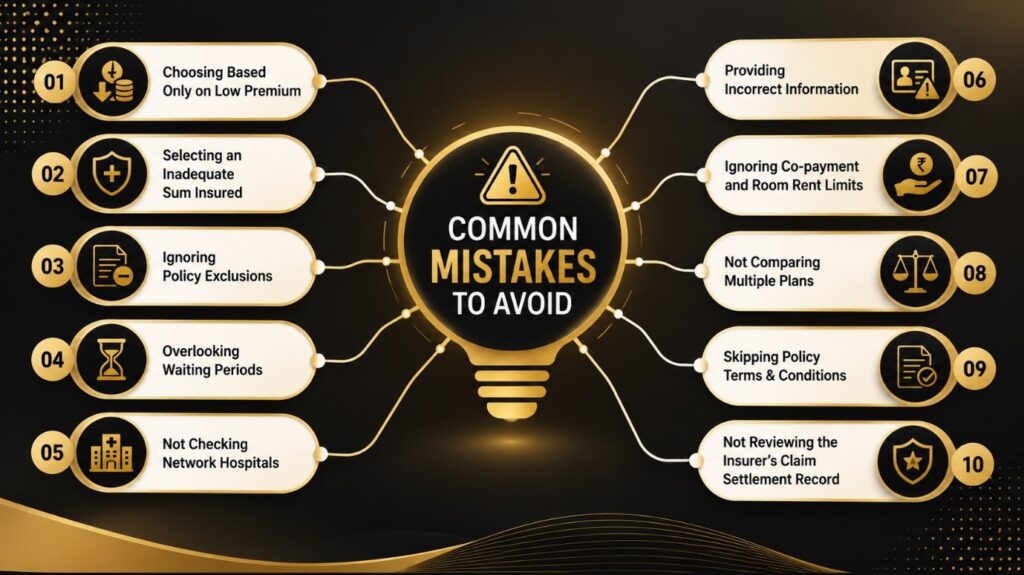
Avoiding these common mistakes will help you select a health insurance plan that provides comprehensive coverage, a smoother claim experience, and long-term financial protection for you and your family.
Tips to Buy Health Insurance for Your Family
Buying health insurance for your family is an important step toward protecting your loved ones from unexpected medical expenses. Choosing the right policy ensures that every family member has access to quality healthcare without creating financial stress. Here are some practical tips to help you make the right decision:
- Assess Your Family’s Healthcare Needs – Consider the age, number of family members, medical history, and future healthcare requirements before selecting a policy.
- Choose an Adequate Sum Insured – Select a coverage amount that can comfortably handle rising medical costs and multiple hospitalization claims.
- Consider a Family Floater Plan – If your family members are generally healthy, a family floater policy can provide comprehensive coverage at a more affordable premium.
- Compare Multiple Health Insurance Plans – Evaluate policies based on coverage, waiting periods, network hospitals, claim settlement record, and premium instead of focusing only on cost.
- Check the Network Hospital List – Ensure the insurer has a wide network of hospitals near your home for easy access to cashless treatment.
- Understand Waiting Periods and Exclusions – Review the policy carefully to know when specific benefits become available and which treatments are not covered.
- Look for Useful Add-On Covers – Consider optional benefits like critical illness cover, maternity cover, or super top-up plans based on your family’s healthcare needs.
- Choose an Insurer with a Good Claim Settlement Record – A reliable insurer can make the claim process faster and less stressful during emergencies.
- Read the Policy Terms Carefully – Understand the coverage, exclusions, renewal conditions, co-payment clauses, and claim procedures before purchasing.
- Review Your Policy Regularly – As your family grows and healthcare needs change, review your coverage periodically to ensure it continues to provide adequate protection.
Following these tips can help you choose a health insurance plan that offers comprehensive coverage, reliable claim support, and long-term financial security for your entire family.
Things to Verify Before Making the Final Purchase
Before purchasing a health insurance policy, take a few minutes to verify all the important details. A careful final review helps you avoid future complications and ensures you choose a policy that truly meets your healthcare and financial needs.
- Confirm the Sum Insured – Make sure the coverage amount is sufficient for your family’s current and future medical expenses.
- Review Policy Coverage – Verify that the policy covers hospitalization, day-care procedures, pre- and post-hospitalization expenses, and other essential medical benefits.
- Check Policy Exclusions – Read the exclusions carefully to understand which treatments, illnesses, or medical expenses are not covered.
- Verify Waiting Periods – Check the waiting periods for pre-existing diseases, specific treatments, and maternity benefits.
- Confirm Network Hospitals – Ensure your preferred hospitals are included in the insurer’s cashless network.
- Understand Claim Process – Verify whether the insurer offers a simple cashless claim facility and an efficient reimbursement process.
- Review Premium and Renewal Terms – Confirm the premium amount, renewal conditions, and whether the policy offers lifetime renewability.
- Check Co-payment and Room Rent Limits – Understand any cost-sharing clauses or room rent restrictions that could affect your claim amount.
- Verify Add-On Covers – Ensure any optional covers you selected, such as critical illness or personal accident cover, are included in the policy.
- Read the Policy Document Carefully – Before making the final payment, review all policy terms, nominee details, personal information, and coverage to ensure everything is accurate.
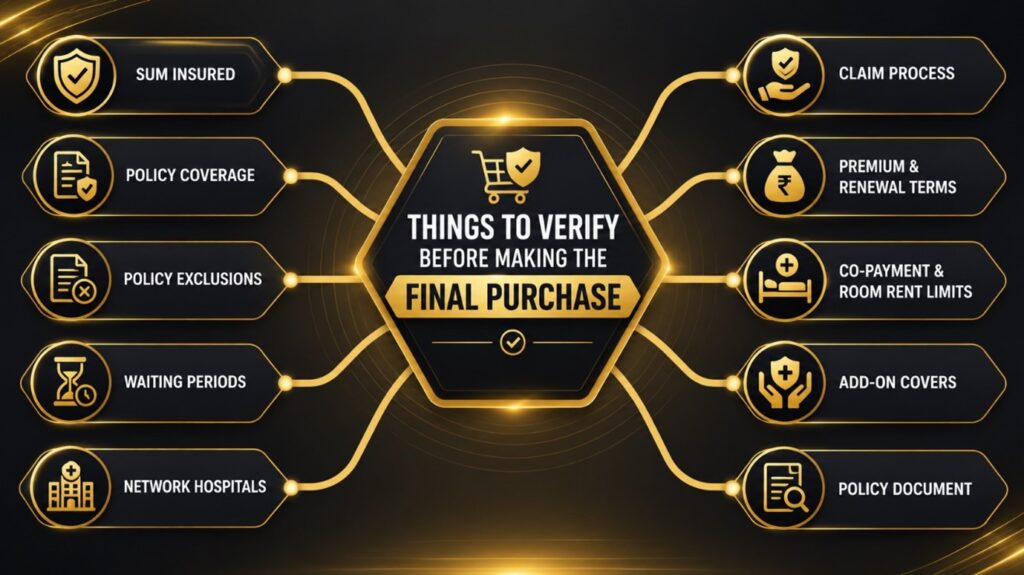
Taking these final verification steps helps you purchase a health insurance policy with confidence, ensuring comprehensive protection and a hassle-free claim experience when you need it most.
Final Takeaway: A Complete Guide to Buying Health Insurance
Buying the right health insurance is one of the most important financial decisions you can make. From understanding different types of plans and choosing the right sum insured to comparing insurers, reviewing policy features, and understanding the claim process, every step plays a vital role in ensuring comprehensive healthcare protection.
Rather than selecting a policy based only on the lowest premium, focus on the overall value it offers. Consider factors such as coverage, waiting periods, network hospitals, claim settlement record, co-payment clauses, add-on covers, and long-term benefits. A well-chosen health insurance plan not only protects you against unexpected medical expenses but also safeguards your savings and financial stability.
If you’re looking for expert assistance, Spiel Wealth helps simplify the process by helping you compare health insurance plans, understand policy features, and choose a solution that aligns with your healthcare needs and long-term financial goals. Making an informed decision today can provide lasting financial security and peace of mind for you and your family.