
What is Claims Support in Health Insurance?
Claims support in health insurance is the assistance provided to policyholders throughout the claim process, from claim intimation to final settlement. It helps ensure that documents are submitted correctly, policy terms are understood, and claims are processed smoothly.
Claims support covers both cashless and reimbursement claims by guiding policyholders on eligibility, documentation, claim tracking, and resolving claim-related queries. This reduces the chances of delays or claim rejection.
Reliable claims support makes the claim process faster, simpler, and less stressful, allowing policyholders to focus on their recovery instead of paperwork.
How the Health Insurance Claim Process Works: Step-by-Step
Understanding the health insurance claim process helps policyholders receive medical benefits without unnecessary delays. While the exact procedure may vary among insurers, the overall process generally follows these steps.
Step 1: Inform the Insurance Company
Notify your insurer or Third-Party Administrator (TPA) as soon as possible after hospitalization. For planned treatments, prior intimation is usually required.
Step 2: Choose the Claim Type
Depending on your policy, you can opt for a cashless claim at a network hospital or a reimbursement claim if treatment is taken elsewhere.
Step 3: Submit the Required Documents
Provide the necessary documents, such as the claim form, hospital bills, discharge summary, medical reports, prescriptions, and identity proof.
Step 4: Claim Verification
The insurer reviews the submitted documents to verify policy coverage, treatment details, and claim eligibility.
Step 5: Claim Approval
If all policy conditions are satisfied, the insurer approves the claim. For cashless claims, the payment is made directly to the hospital, while reimbursement claims are settled with the policyholder.
Step 6: Claim Settlement
Once approved, the claim is settled as per the policy terms, and the policyholder receives confirmation from the insurer.
Keeping your documents complete and informing the insurer on time can help ensure a faster and hassle-free claim process.
Cashless vs Reimbursement Claims: Which One Should You Choose?
Both cashless and reimbursement claims help you receive health insurance benefits, but the process and payment method are different. Understanding these differences can help you choose the most suitable option during a medical emergency.
| Feature | Cashless Claim | Reimbursement Claim |
| Hospital Requirement | Available only at network hospitals. | Can be used at any eligible hospital, subject to policy terms. |
| Payment Process | Insurer directly settles eligible bills with the hospital. | Policyholder pays the bills first and later claims reimbursement from the insurer. |
| Upfront Expenses | Minimal, except for non-covered expenses. | Entire hospital bill is paid by the policyholder initially. |
| Documentation | Hospital and insurer complete most formalities. | Policyholder submits all bills, reports, and claim documents. |
| Claim Processing | Usually faster as the insurer coordinates directly with the hospital. | Takes longer because documents are verified after submission. |
| Best Suitable For | Planned treatments or emergencies at network hospitals. | Treatment at non-network hospitals or where cashless service is unavailable. |
Which One Should You Choose?
If treatment is available at a network hospital, a cashless claim is generally the more convenient option because it reduces the need for large upfront payments. A reimbursement claim is useful when treatment is taken at a non-network hospital or when cashless facilities are not available. Choosing the right option depends on your hospital, policy terms, and the medical situation.
Documents Required for a Successful Health Insurance Claim
Submitting the correct documents is essential for smooth and timely health insurance claim processing. Complete and accurate documentation helps the insurer verify your claim and reduces the chances of delays or rejection.
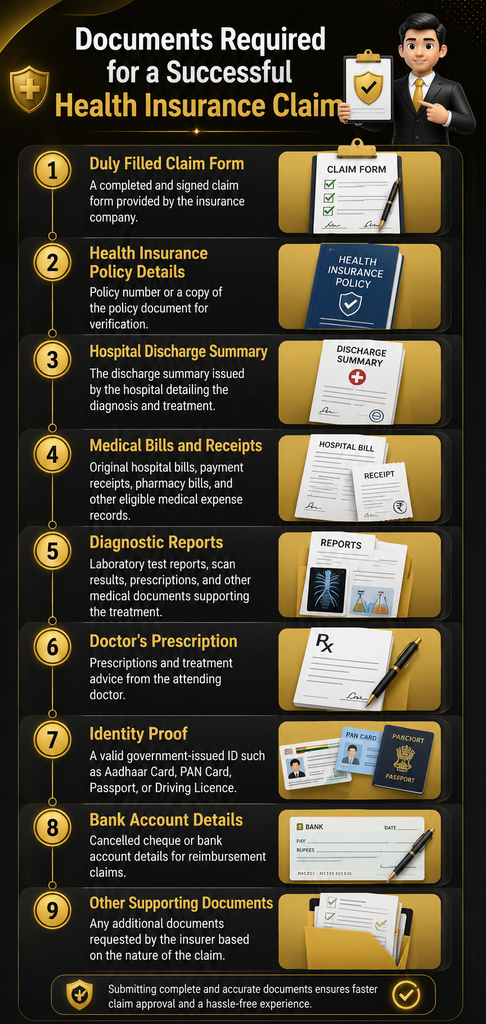
Before submitting your claim, always verify the insurer’s document checklist, as requirements may vary depending on the policy and claim type. Proper documentation can significantly improve the chances of faster claim approval.
Common Reasons Why Health Insurance Claims Get Rejected
Health insurance claims can be rejected for several reasons, many of which can be avoided with proper awareness and timely action. Understanding these common causes helps policyholders improve the chances of successful claim approval.
Incomplete or Incorrect Documents
Missing claim forms, medical reports, hospital bills, or incorrect information can delay or lead to claim rejection.
Non-Disclosure of Medical History
Failing to disclose pre-existing diseases or important health information while purchasing the policy may result in claim denial.
Treatment Not Covered
Claims for illnesses, procedures, or treatments excluded under the policy are generally not approved.
Waiting Period Not Completed
If the claim is made before completing the applicable waiting period, the insurer may reject it.
Policy Lapse
An inactive or expired policy due to unpaid premiums is not eligible for claim settlement.
Hospital Not Eligible
Cashless claims may be rejected if treatment is taken at a non-network hospital without following the required process.
Delay in Claim Intimation
Not informing the insurer within the prescribed timeline can affect claim approval.
Exceeding Policy Limits
Expenses beyond the policy’s coverage limits, room rent limits, or sub-limits may not be payable.
Fraudulent or Misleading Information
Providing false documents or incorrect claim details can lead to immediate claim rejection.
Violation of Policy Terms
Failure to comply with the policy’s conditions and claim procedures may result in denial of the claim.
Understanding your policy terms, maintaining complete documentation, and following the insurer’s claim process can significantly reduce the risk of health insurance claim rejection.
Tips to Ensure Faster and Hassle-Free Health Insurance Claim Approval
A smooth health insurance claim process depends on proper planning, accurate documentation, and following the insurer’s guidelines. These simple tips can help improve the chances of quick and successful claim approval.
Understand Your Policy
Read your policy carefully to know the coverage, exclusions, waiting periods, and claim conditions before hospitalization.
Inform the Insurer on Time
Notify the insurance company or TPA as soon as possible, especially for planned hospitalizations.
Keep All Documents Ready
Maintain original hospital bills, discharge summaries, prescriptions, diagnostic reports, and identity proof for claim submission.
Choose a Network Hospital
For cashless treatment, use a network hospital to simplify the approval process and reduce upfront expenses.
Submit Accurate Information
Ensure that all claim forms and supporting documents are complete and free from errors.
Follow the Claim Procedure
Complete every step of the insurer’s claim process and submit documents within the prescribed timeline.
Track Your Claim Status
Regularly monitor the progress of your claim and respond promptly if the insurer requests additional information.
Keep Copies of All Documents
Retain copies of every document submitted for future reference or clarification.
Following these best practices can help minimize delays, avoid unnecessary complications, and ensure a faster and hassle-free health insurance claim experience.
How to Track Your Health Insurance Claim Status
Tracking your health insurance claim helps you stay informed about its progress and respond quickly if the insurer requires additional information. Most insurance companies provide multiple ways to monitor the status of a claim.
Visit the Insurer’s Website
Log in to your insurer’s official website using your policy or claim details to check the latest claim status.
Use the Mobile App
Many insurers offer mobile applications that allow policyholders to track claims in real time.
Contact Customer Support
You can call the insurer’s customer care team or Third-Party Administrator (TPA) to get updates on your claim.
Check Through the Hospital
For cashless claims, the hospital’s insurance desk can often provide updates on the approval and settlement process.
Keep Your Claim Number Ready
Always keep your claim reference number or policy number handy, as it is required for tracking the claim.
Respond to Additional Requests
If the insurer asks for more documents or clarification, submit the required information promptly to avoid delays.
Regularly tracking your health insurance claim helps ensure a smoother process and allows you to address any issues quickly, leading to faster claim settlement.
What to Do If Your Health Insurance Claim is Rejected
A health insurance claim rejection does not always mean the end of the process. The first step is to carefully read the rejection letter or communication from the insurer to understand the exact reason for the denial. In many cases, claims are rejected due to incomplete documentation, missing information, policy exclusions, or failure to meet specific policy conditions rather than because the treatment itself is not covered.
Once you know the reason, review your health insurance policy and compare it with the insurer’s explanation. If the rejection occurred because of missing documents or incorrect details, you can often submit the required information and request the insurer to reassess the claim. Keeping all medical records, hospital bills, discharge summaries, prescriptions, and diagnostic reports organized makes this process much easier.
If you believe the claim has been rejected unfairly, you have the right to raise a formal grievance with the insurance company. Most insurers have a dedicated grievance redressal system to review disputed claims. If the issue remains unresolved after following the insurer’s grievance process, you may escalate the matter to the appropriate regulatory dispute resolution mechanism, as permitted under applicable insurance regulations.
To reduce the chances of future claim rejections, always understand your policy coverage, disclose accurate medical information while purchasing the policy, inform the insurer within the required timeline, and submit complete claim documents. Proper planning and timely communication can significantly improve the likelihood of successful claim settlement.
Health Insurance Claim Settlement: Important Terms Every Policyholder Should Know
Understanding common health insurance claim terms can help you navigate the claim process more confidently and avoid confusion during medical emergencies. Knowing these terms also makes it easier to understand your policy benefits and claim settlement.
Claim Settlement
The process through which the insurance company reviews, approves, and pays an eligible health insurance claim according to the policy terms.
Cashless Claim
A claim where the insurer directly settles eligible medical expenses with a network hospital, reducing the need for upfront payment by the policyholder.
Reimbursement Claim
A claim in which the policyholder pays the hospital expenses first and later submits the required documents to the insurer for reimbursement.
Sum Insured
The maximum amount the insurer will pay for eligible medical expenses during a policy year.
Network Hospital
A hospital that has a tie-up with the insurance company to provide cashless treatment facilities.
Waiting Period
The specified time during which certain illnesses, treatments, or pre-existing diseases are not covered under the policy.
Co-payment
A fixed percentage of the medical expenses that the policyholder must pay, while the insurer covers the remaining eligible amount.
Deductible
The amount that the policyholder must bear before the insurance company starts paying the eligible claim amount.
Third-Party Administrator (TPA)
An organization authorized by the insurer to manage claim processing, documentation, and cashless claim coordination.
Claim Intimation
The process of informing the insurer or TPA about hospitalization or a planned medical treatment before submitting a claim.
Understanding these important terms helps policyholders make informed decisions, avoid claim-related misunderstandings, and experience a smoother health insurance claim settlement process.
How Spiel Wealth Helps You with End-to-End Health Insurance Claims Support
At Spiel Wealth, we support you throughout the entire health insurance claim process, making it simpler and less stressful. From claim intimation to final settlement, our team helps you understand the procedure, prepare the required documents, and track your claim status.
Whether it is a cashless or reimbursement claim, we provide guidance at every stage to help reduce delays and avoid common claim-related issues. We also assist in understanding policy terms and documentation requirements, ensuring a smoother claim experience.
With Spiel Wealth, you get more than just a health insurance policy—you get reliable claims support whenever you need it most.
Conclusion
A smooth health insurance claim process is just as important as choosing the right policy. Understanding the claim procedure, keeping the required documents ready, and following the insurer’s guidelines can help reduce delays and improve the chances of successful claim settlement. With the right claims support, policyholders can focus on their recovery instead of worrying about paperwork. Having a trusted partner like Spiel Wealth ensures expert assistance at every stage, making the health insurance claim experience faster, simpler, and more hassle-free.