
Accident Health Insurance vs Regular Health Insurance: Understanding the Key Differences
Although both Accident Health Insurance and Regular Health Insurance provide financial protection, they cover different types of medical risks. A regular health insurance policy offers broad coverage for illnesses and hospitalization, while accident health insurance specifically covers expenses arising from accidental injuries or disability. Understanding these differences can help you choose the right protection based on your needs.
| Feature | Accident Health Insurance | Regular Health Insurance |
| Purpose | Covers financial losses caused by accidents. | Covers hospitalization and medical expenses due to illnesses and accidents. |
| Coverage | Accidental injury, disability, accidental death, and related treatment (as per policy terms). | Hospitalization, surgeries, day-care procedures, illnesses, and accident-related treatment. |
| Hospitalization | Covered only if caused by an accident. | Covered for eligible illnesses and accidents. |
| Critical Illness | Usually not covered unless specifically included. | May be covered through an add-on or separate policy. |
| Accidental Death Benefit | Generally provides a lump-sum benefit. | Not included in a standard health insurance policy. |
| Premium | Usually lower because coverage is limited to accidents. | Depends on age, coverage amount, health condition, and policy benefits. |
| Best Suitable For | Individuals seeking additional protection against accident-related risks. | Anyone looking for comprehensive medical coverage. |
Which One Should You Choose?
If you want protection against medical expenses caused by illnesses, surgeries, and hospitalization, a Regular Health Insurance Plan is essential. If you are looking for additional financial security against accidental injuries, disability, or accidental death, an Accident Health Insurance Plan can be a valuable supplement.
For comprehensive protection, many individuals choose to have both a regular health insurance policy and an accident insurance policy, ensuring broader financial coverage against a wide range of medical and accidental risks.
Why Is Accident Insurance Cover Important? Benefits, Features, and Importance
Accidents can happen unexpectedly and may result in injuries, disability, hospitalization, or even loss of income. While regular health insurance covers medical expenses for illnesses and accidents, Accident Insurance is designed specifically to provide financial protection against accident-related risks. It helps policyholders manage treatment costs and offers additional financial support during difficult times.
Benefits, Features, and Importance of Accident Insurance
| Aspect | Explanation |
| Financial Protection | Provides financial assistance for expenses arising from accidental injuries, disability, or accidental death, as per the policy terms. |
| Accidental Hospitalization Cover | Helps cover eligible hospitalization and treatment costs resulting from an accident. |
| Disability Benefit | Offers compensation in case of permanent or partial disability caused by an accident, subject to policy conditions. |
| Accidental Death Benefit | Pays a lump-sum amount to the nominee if the insured dies due to an accident covered under the policy. |
| Income Support | Some plans provide compensation for temporary loss of income if the insured is unable to work due to accidental injuries. |
| Affordable Premiums | Accident insurance generally comes at a lower premium compared to comprehensive health insurance because it covers only accident-related events. |
| Worldwide Coverage | Many accident insurance policies provide protection against covered accidents occurring anywhere in the world, depending on the policy. |
| Additional Security | Works as a supplement to regular health insurance by covering accident-specific financial risks that may not be fully covered under a standard health policy. |
Why Is Accident Insurance Important?
- Provides financial support during unexpected accidents.
- Reduces the financial burden of accident-related medical expenses.
- Helps protect family finances in case of disability or accidental death.
- Offers peace of mind for individuals with active lifestyles or high-risk occupations.
- Complements regular health insurance by providing broader financial protection.
Accident insurance is not a replacement for regular health insurance but an important additional layer of protection. Having both policies can help ensure comprehensive financial security against medical emergencies as well as accident-related risks.
Yeh raha without “Why Accident Coverage is Important” points, blog flow ke hisaab se:
How Does Accident Coverage Work in Health Insurance Policies?
Accident coverage in a health insurance policy provides financial protection when the insured suffers an injury due to an accident. Depending on the policy, it may cover hospitalization expenses, surgeries, emergency treatment, and other eligible medical costs arising directly from accidental injuries. Some policies also offer additional benefits such as compensation for disability or accidental death through an accident insurance rider or a separate personal accident policy.
Unlike regular health insurance, which covers a wide range of illnesses and medical conditions, accident coverage is limited to injuries caused by accidental events. Claims are settled only if the accident and the related medical expenses fall within the policy’s coverage, terms, and conditions.
How Accident Coverage Works
Accident Occurs
The insured experiences an accidental injury that requires immediate medical attention or hospitalization.
Receive Medical Treatment
The insured receives treatment at a network or non-network hospital, depending on the policy and the nature of the emergency.
Notify the Insurer
The insurance company or Third-Party Administrator (TPA) should be informed within the timeline specified in the policy for initiating the claim process.
Submit the Required Documents
The policyholder submits the necessary documents, including the claim form, hospital records, discharge summary, medical reports, and original bills.
Claim Verification
The insurer reviews the claim to verify that the accident, treatment, and expenses are covered under the policy terms and conditions.
Claim Settlement
Once the claim is approved, the insurer either settles the hospital expenses directly through the cashless facility or reimburses the eligible medical expenses to the policyholder.
Understanding this process helps policyholders complete claim formalities efficiently and receive eligible benefits without unnecessary delays during medical emergencies.
Personal Accident Insurance Policy: A Complete Guide for Beginners
A Personal Accident Insurance Policy provides financial protection against losses caused by accidental injuries, disability, or accidental death. It helps reduce the financial burden on the insured and their family during unexpected accidents.
What is a Personal Accident Insurance Policy?
It is an insurance plan that offers financial compensation if the insured suffers an accident resulting in injury, disability, or death, as per the policy terms.
What Does It Cover?
Most policies cover accidental hospitalization, permanent or partial disability, accidental death, and other accident-related benefits, depending on the insurer.
Who Should Buy It?
It is suitable for salaried employees, business owners, self-employed professionals, students, homemakers, and individuals working in high-risk occupations.
Why is It Important?
Since accidents are unpredictable, a personal accident policy provides additional financial security beyond regular health insurance.
Things to Check Before Buying
Compare the sum insured, policy coverage, exclusions, claim process, premium, and additional benefits before choosing a policy.
A Personal Accident Insurance Policy is an affordable way to strengthen your financial protection and safeguard your family against the unexpected impact of accidents.
How Health Insurance Helps Manage Medical Expenses After an Accident
Accidents can lead to unexpected medical expenses, including emergency treatment, hospitalization, surgeries, and rehabilitation. A health insurance policy helps reduce this financial burden by covering eligible accident-related medical costs according to the policy terms and conditions.
Covers Emergency Hospitalization
Health insurance helps pay for hospitalization expenses if an accident requires immediate medical care.
Pays for Surgery and Medical Treatment
If surgery or specialized treatment is needed due to an accidental injury, the policy covers eligible expenses as specified in the plan.
Covers Pre- and Post-Hospitalization Expenses
Many health insurance plans reimburse medical costs incurred before admission and after discharge, including consultations, diagnostic tests, and prescribed medicines.
Includes Day-Care Procedures
Certain accident-related treatments that do not require 24-hour hospitalization may also be covered under eligible day-care procedures.
Provides Cashless Treatment
If treatment is taken at a network hospital, the insurer may settle eligible hospital bills directly through the cashless facility, reducing the need for upfront payments.
Protects Your Savings
By covering eligible medical expenses, health insurance helps prevent individuals and families from using their personal savings to pay large hospital bills.
Supports Recovery with Better Healthcare Access
Financial support from health insurance allows policyholders to access quality medical treatment and focus on recovery instead of worrying about treatment costs.
Works Alongside Personal Accident Insurance
While health insurance primarily covers medical expenses, a Personal Accident Insurance Policy may provide additional financial benefits for accidental disability or accidental death, offering broader financial protection.
Having adequate health insurance ensures that unexpected accidents do not become a major financial burden. Choosing a policy with comprehensive accident-related medical coverage helps provide peace of mind and financial security during emergencies.
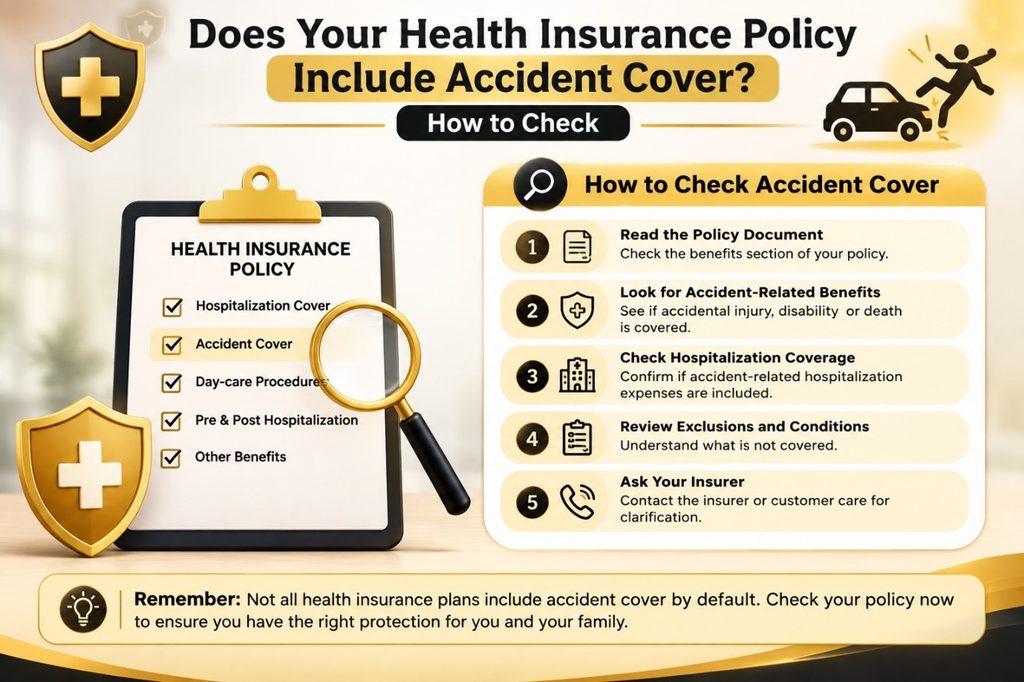
Personal Accident Cover vs Critical Illness Cover: Key Differences Explained
Although Personal Accident Cover and Critical Illness Cover both provide financial protection, they serve different purposes. A Personal Accident Cover protects against financial losses caused by accidental injuries, disability, or accidental death, while a Critical Illness Cover provides a lump-sum benefit when the insured is diagnosed with specified serious illnesses covered under the policy.
Understanding the differences between these two covers helps you choose the right protection based on your health risks and financial needs.
| Feature | Personal Accident Cover | Critical Illness Cover |
| Purpose | Covers financial losses resulting from accidents. | Provides financial support after the diagnosis of specified critical illnesses. |
| Coverage | Accidental injury, permanent disability, partial disability, and accidental death (as per policy terms). | Serious illnesses such as cancer, heart attack, stroke, kidney failure, and other covered diseases. |
| Benefit Type | Compensation based on the accident and its impact. | Lump-sum payout after diagnosis of a covered critical illness. |
| Hospitalization Requirement | May or may not require hospitalization, depending on the accident and policy. | Diagnosis of a covered illness is generally required; hospitalization depends on the illness and policy terms. |
| Cause of Claim | Only accidental events. | Only illnesses specifically listed in the policy. |
| Premium | Usually lower due to limited accident-specific coverage. | Generally higher because it covers major illnesses with high treatment costs. |
| Best Suitable For | Individuals seeking protection against accidental risks. | Individuals seeking financial support for expensive critical illness treatments. |
Which Cover Should You Choose?
Choose Personal Accident Cover If:
- You want financial protection against accidental injuries and disability.
- You work in a high-risk occupation or travel frequently.
- You want additional security for your family in case of accidental death.
Choose Critical Illness Cover If:
- You want financial support for expensive treatments of serious illnesses.
- You have a family history of major diseases.
- You are looking to protect your savings from high medical costs associated with critical illnesses.
Can You Have Both Covers?
Yes. Personal Accident Cover and Critical Illness Cover complement each other because they protect against different risks. Having both can provide broader financial protection by covering accident-related events as well as major life-threatening illnesses, helping you and your family stay financially secure during unexpected situations.
What Expenses Are Covered Under Accident Insurance?
Accident insurance is designed to provide financial protection against expenses and losses resulting from accidental injuries. Depending on the insurer and the policy chosen, it can help cover medical costs as well as provide compensation for accident-related disabilities or death. Understanding what is covered helps you choose a policy that meets your financial protection needs.
Expenses Covered Under Accident Insurance
Emergency Hospitalization
Covers eligible hospitalization expenses if the insured is admitted to a hospital due to an accidental injury.
Medical Treatment Expenses
Pays for eligible medical treatments, surgeries, doctor consultations, medicines, and diagnostic tests required because of an accident, subject to policy terms.
Ambulance Charges
Many accident insurance policies cover ambulance expenses incurred while transporting the insured to a hospital after an accident.
Day-Care Procedures
Certain accident-related treatments that do not require 24-hour hospitalization may also be covered if specified in the policy.
Accidental Disability Benefit
Provides financial compensation if the insured suffers permanent total disability, permanent partial disability, or, in some cases, temporary total disability due to an accident.
Accidental Death Benefit
If the insured dies as a result of a covered accident, the policy pays the insured sum to the nominee according to the policy conditions.
Rehabilitation Expenses
Some policies may provide benefits for physiotherapy, rehabilitation, or recovery services required after an accident.
Hospital Daily Cash Allowance
Certain plans offer a fixed daily cash benefit for each day of hospitalization due to an accident, helping cover incidental expenses.
Education Benefit for Children
Some accident insurance policies provide financial assistance for dependent children’s education if the insured suffers accidental death or permanent disability.
Transportation of Mortal Remains
Certain insurers cover the cost of transporting the insured’s mortal remains following a covered accidental death.
Accident insurance acts as an important financial safety net by covering accident-related medical expenses and offering compensation for disability or accidental death, helping protect both the insured and their family’s financial well-being.
How to Choose the Best Accident Insurance Plan: Important Factors to Consider
An accident insurance plan provides financial protection against accidental injuries, disability, and accidental death. However, not every policy offers the same level of coverage. Comparing important features before purchasing helps you choose a plan that meets your financial and healthcare needs.
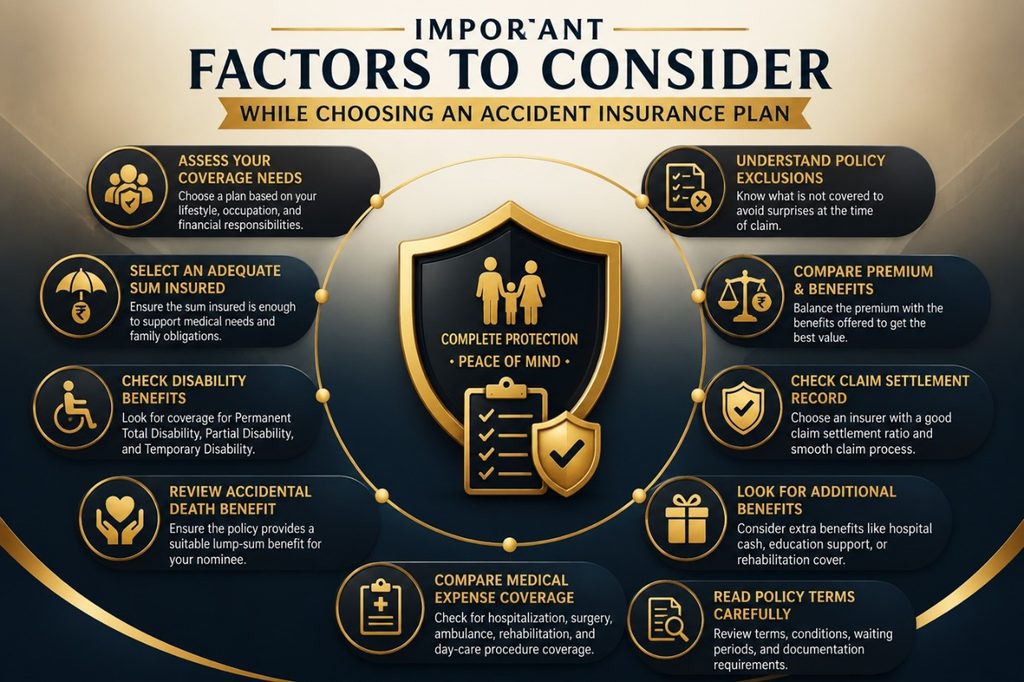
Choosing the right accident insurance plan after comparing these factors helps ensure comprehensive financial protection against unexpected accidents while providing peace of mind for you and your family.
Accidental Death and Permanent Disability Cover: Complete Explanation
Accidental Death and Permanent Disability Cover is an important benefit offered under many Personal Accident Insurance Policies. It provides financial protection if the insured suffers permanent disability or loses their life due to an accident covered under the policy. These benefits help reduce the financial burden on the insured and their family during difficult situations.
What is Accidental Death Cover?
Accidental Death Cover provides a lump-sum payout to the nominee if the insured passes away due to an accident covered under the policy. This financial support can help the family manage daily living expenses, outstanding loans, children’s education, and other future financial commitments.
Key Features
- Lump-sum benefit paid to the nominee.
- Covers death resulting from a covered accident.
- Helps provide financial security to the insured’s family.
- Available as part of most Personal Accident Insurance Plans.
What is Permanent Disability Cover?
Permanent Disability Cover provides financial compensation if an accident causes the insured to suffer a permanent disability that affects their ability to work or perform daily activities. The compensation amount depends on the type and extent of disability mentioned in the policy.
Types of Permanent Disability
Permanent Total Disability (PTD)
This applies when the insured permanently loses the ability to work due to severe accidental injuries, such as the loss of both limbs, total loss of eyesight, or other disabilities defined in the policy.
Permanent Partial Disability (PPD)
This applies when the insured suffers a permanent injury affecting a specific body part, such as the loss of one hand, one leg, or the loss of vision in one eye. Compensation is usually paid according to the percentage specified in the policy.
Benefits of These Covers
Financial Security
Provides financial assistance to the insured or their family during unexpected situations caused by accidents.
Income Protection
Compensation helps manage the loss of income resulting from permanent disability.
Family Support
The lump-sum benefit can help meet household expenses, loan repayments, education costs, and other financial responsibilities.
Affordable Protection
These covers are generally available at affordable premiums while offering significant financial benefits.
Accidental Death and Permanent Disability Cover provides valuable financial protection against the long-term impact of serious accidents. Choosing a policy with adequate coverage ensures that both you and your family are better prepared to handle unforeseen financial challenges resulting from accidental injuries or loss of life.
Road Accident Insurance Claim Process: Step-by-Step Guide
A road accident can result in unexpected medical expenses and financial stress. If you have accident insurance or a health insurance policy that covers accident-related treatment, following the correct claim process helps ensure faster claim settlement. Understanding each step in advance can make the process smoother during an emergency.
Step 1: Get Immediate Medical Assistance
Your first priority should always be the safety of everyone involved. Seek immediate medical treatment and, if necessary, call an ambulance. Preserve all medical records, prescriptions, and hospital bills.
Step 2: Inform the Insurance Company
Notify your insurance company or Third-Party Administrator (TPA) as soon as possible. Most insurers require claim intimation within the timeline specified in the policy.
Step 3: Report the Accident
If required, report the accident to the nearest police station and obtain a First Information Report (FIR) or other relevant police documents, especially in cases involving serious injuries or third-party damage.
Step 4: Collect Required Documents
Keep all necessary documents ready for the claim process, including:
- Duly filled claim form
- Health or accident insurance policy details
- Hospital admission and discharge summary
- Medical reports and prescriptions
- Original medical bills and payment receipts
- FIR (if applicable)
- Identity proof
- Doctor’s certificate and diagnostic reports
Step 5: Submit the Claim
Submit the claim form along with all required documents to the insurer. For cashless treatment, the hospital generally coordinates with the insurer. For reimbursement claims, the policyholder submits the documents after treatment.
Step 6: Claim Verification
The insurer reviews the submitted documents and verifies the accident details, medical treatment, and policy coverage before processing the claim.
Step 7: Claim Approval and Settlement
Once verification is completed, the insurer approves eligible claims according to the policy terms. Payment is made either directly to the hospital (cashless claim) or reimbursed to the policyholder.
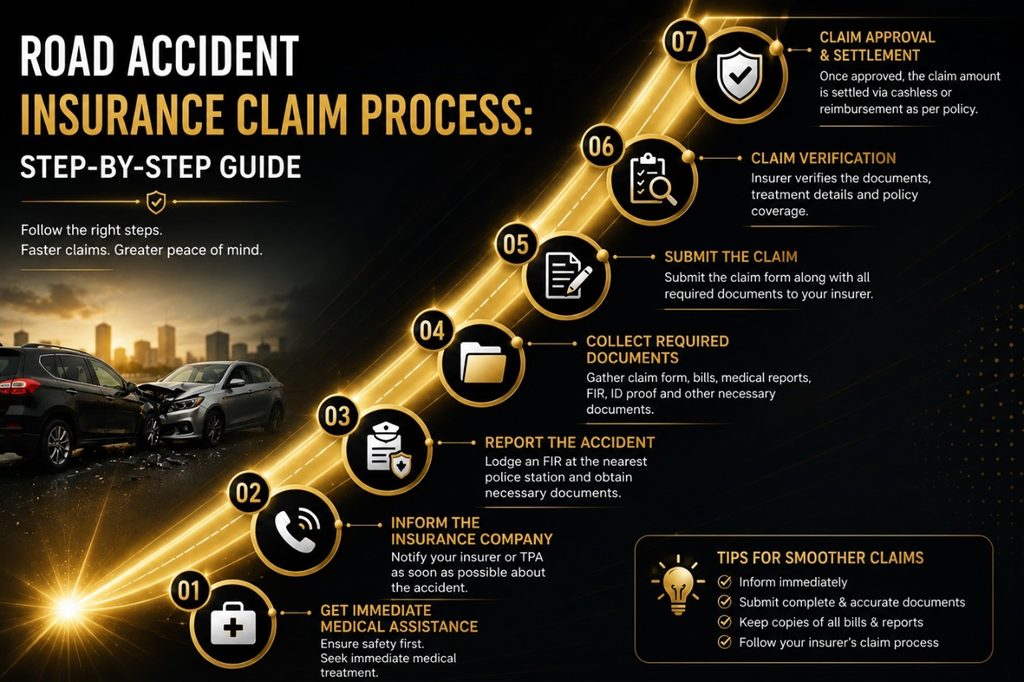
Following these steps helps simplify the road accident insurance claim process and improves the chances of a smooth and timely claim settlement. Being familiar with the procedure before an emergency can save valuable time and reduce unnecessary stress.
Future of Accident Insurance in India: Rising Healthcare Costs and Financial Security
Accident insurance is becoming increasingly important in India as healthcare expenses continue to rise and lifestyles become more fast-paced. Road accidents, workplace injuries, and unexpected emergencies can lead to significant medical costs and loss of income. An accident insurance policy helps individuals and families stay financially protected by providing support during such unforeseen situations.
As medical inflation continues to increase, the demand for affordable and comprehensive accident insurance plans is expected to grow. Insurers are also introducing innovative products with enhanced benefits to meet changing customer needs.
Why Accident Insurance Will Become More Important
Rising Healthcare Costs
Hospitalization, surgeries, rehabilitation, and emergency treatments are becoming more expensive every year. Accident insurance helps reduce the financial burden of these unexpected medical expenses.
Increasing Road Accidents
India records a large number of road accidents annually. With more vehicles on the road, the need for financial protection against accident-related risks continues to increase.
Growing Financial Awareness
More people now understand the importance of protecting themselves against unforeseen financial risks, leading to greater demand for accident insurance.
Better Insurance Products
Insurance companies are continuously improving accident insurance plans by offering higher coverage, flexible benefits, and optional add-on covers for enhanced protection.
Faster Digital Claim Settlement
Digital claim submission, online policy management, paperless documentation, and quicker claim processing are making accident insurance more convenient for policyholders.
Protection Against Income Loss
Serious accidents can affect a person’s ability to work. Accident insurance provides financial assistance in cases of permanent or partial disability, helping individuals manage their financial responsibilities.
Affordable Premiums
Compared to many other insurance products, accident insurance offers substantial financial protection at relatively affordable premium rates, making it accessible to a wider population.
Stronger Financial Security for Families
In case of accidental death or permanent disability, the financial benefits received under the policy can help families manage household expenses, education costs, loan repayments, and other long-term financial commitments.
Future Trends in Accident Insurance
- Increased use of digital platforms for policy purchase and claim settlement.
- More customized accident insurance plans for different professions and lifestyles.
- Better integration with health insurance through optional riders and add-on covers.
- Expansion of cashless treatment facilities for accident-related hospitalization.
- Greater focus on customer-friendly services and faster claim processing.